
Leather on the Party Floor
Leather is a material. Leather culture is not. And... what the hell is that?

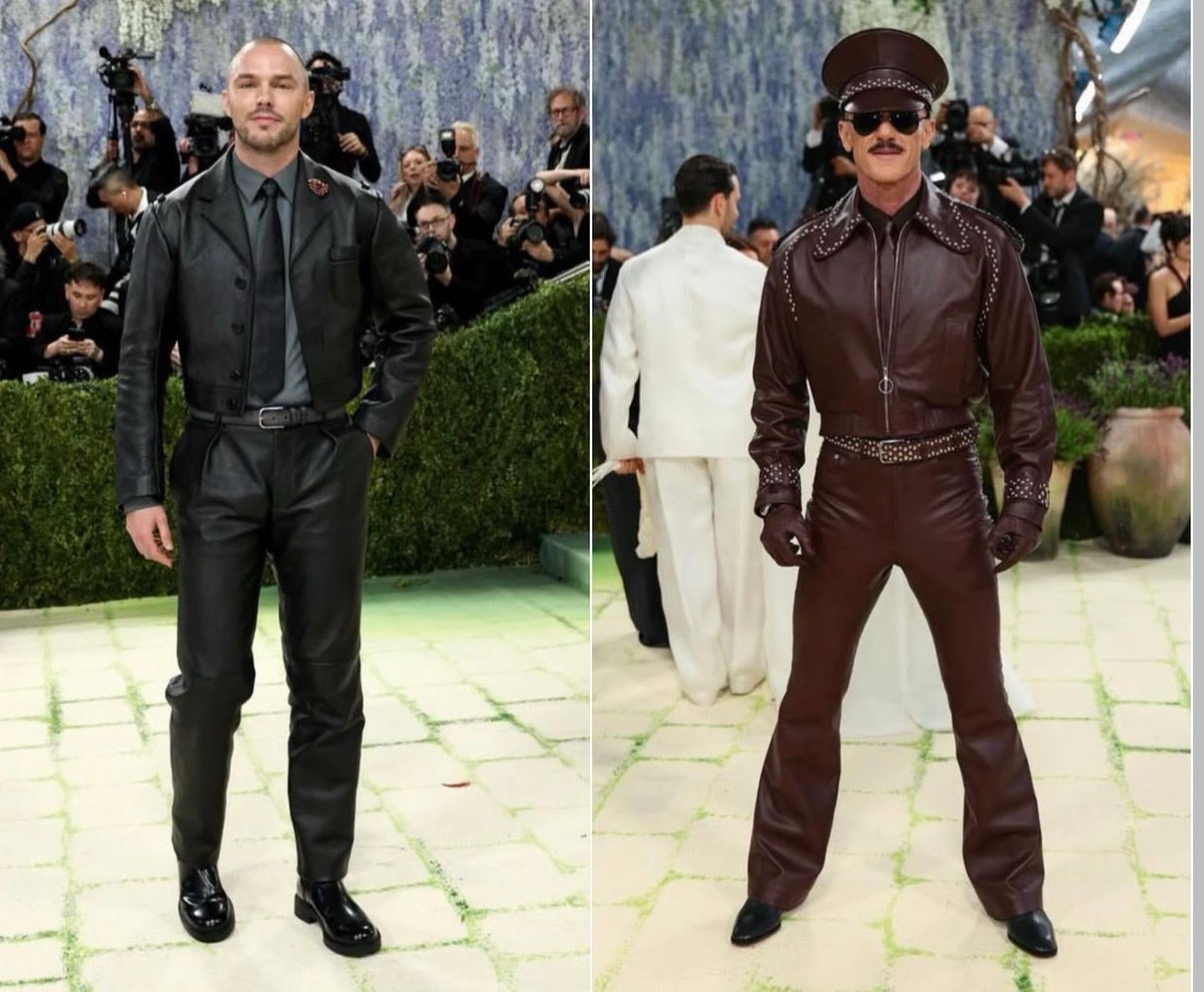
At this year’s Met Gala, Luke Evans showed up in a full leather outfit — oxblood brown, studded from collar to cuff, with a Muir-ish cap and gloves — and told the cameras it was inspired by Tom of Finland. The mainstream fashion press swooned, a big part of queer community echoed. “Leather daddy realness!” “He nailed it!” “A powerful statement about queer cultural contributions to fashion!”
Meanwhile, in my leather circle, the reaction was almost uniform: What the hell is that?!
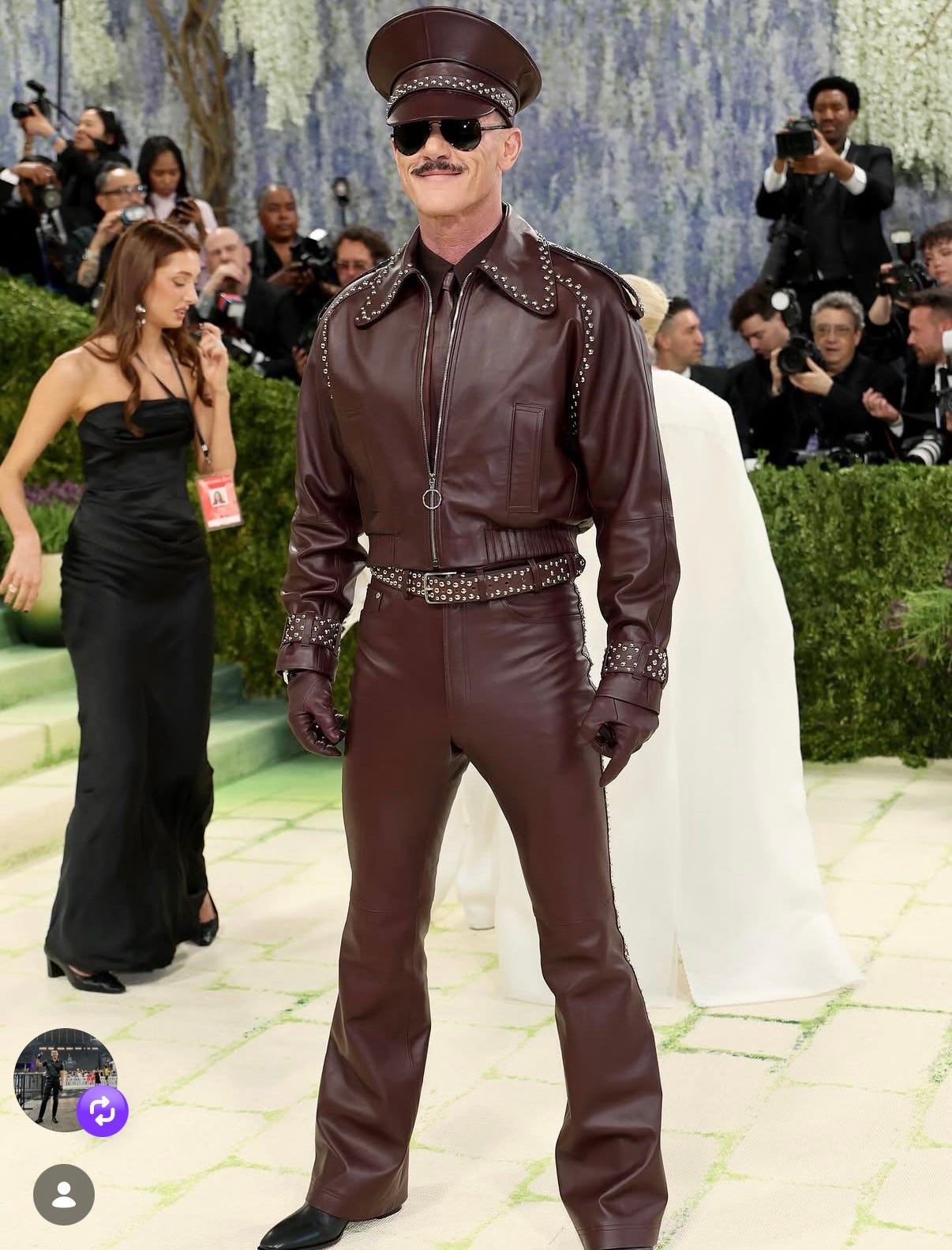
Not because others cannot wear leather. Not because fashion has to be purist. But because the outfit demonstrates, with remarkable precision, a complete failure to understand the culture it claims to honor. It is leather cosplay presented as leather culture. And the gap between those two things is the entire point.
Let’s start with what’s actually wrong with the outfit — not by the standards of some rigid dress code, but by the internal logic of the aesthetic Evans explicitly invoked.
The color. Tom of Finland’s leather is overwhelmingly black. His drawings are rendered in high-contrast graphite — black leather, grey jeans, dark shadow. The entire visual language of the leather culture he helped shape is built on black: the post-war biker rebellion, Brando in The Wild One, the Folsom aesthetic, Mapplethorpe, Freddie Mercury. Black is powerful, mysterious, deep. Black leather carries cultural weight. It signals a lineage. The brown-ish color choice alone tells you this was designed by someone who only glanced at leather culture, not from inside it — let alone the political ignorance around the color, which is most probably unintentional from unawareness..
The fit. Tom of Finland’s men are sculpted by their leather. Impossibly broad shoulders, narrow waists, thighs straining against the material. The clothing is second-skin, almost architectural — it doesn’t just cover the body, it amplifies masculine power onto it. And the bulge — the only thing people feel as a miss who cheer at the outfit — is missing exactly because the fit doesn’t support that amplification. Tom of Finland’s men look like they were poured into their gear. Evans looks like he’s wearing a halloween costume hinting something vaguely kinky.
The studs. In leather culture, hardware has function. Heavy zippers. Snap closures. The weight of real bronze buckles. Tom of Finland’s details are always functional or militaristic: epaulettes, straps, holsters, boots with structural integrity. Evans’s studs are purely ornamental, as if they had bought too many and had to use them all — decorative embellishment running down the seams like rhinestones on a Nashville jacket. In the leather world, the difference between functional hardware and decorative studs is the difference between a chain collar with a lock from Home Depot and a choker from H&M.
The cap. A Muir cap has specific, rigid geometry — high crown, stiff brim, authoritative structure. What Evans is wearing looks like it came from a party supply store’s “sexy cop” section. Yes, the more similar East European military officer caps are also adopted in leather culture, but here it just enhances the ridiculousness of the whole look.
The posture. Striking a pose like he’s at a press call for a Disney franchise. Tom of Finland’s men own space. They project unapologetic sexual power. They don’t pose — they occupy. The body language tells you everything about the gap between referencing a culture and inhabiting one.
If anything, the flared trousers and decorative studs give the outfit more in common with ABBA’s stage costumes than with anything Tom of Finland ever drew. Mamma Mia indeed. Tom of Finland drew men who looked like they could pin you against a wall. Evans looks like he’s about to perform “Waterloo” at Eurovision.
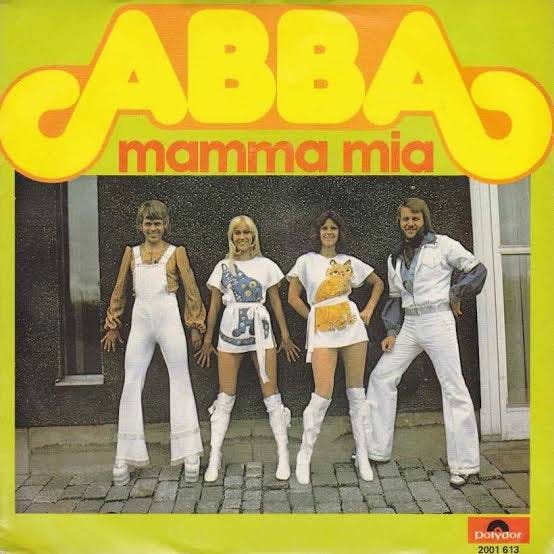
None of this is about rigid gatekeeping of what leather “must” look like. This is about the fact that every single element— color, hardware, fit, silhouette, posture — contradicts the aesthetic the outfit is claiming to channel. Tom of Finland is gonna join Michael Jackson’s Thriller crew if you keep saying his work is the inspiration of this.
But the outfit is only the symptom. The real issue is the applause around it. We understand this principle perfectly when it applies to other cultures. No one would accept a celebrity showing up to the Met Gala in a loosely draped pastel kimono with random kanji printed on it and telling the press it was "inspired by Japanese culture." No one would nod approvingly at a feathered headdress worn as a fashion statement with the explanation that it was "a tribute to Indigenous art." The internet would — rightly — tear it apart, because we recognize that these are cultures with specific meanings, specific histories, and specific communities who get to say whether the homage lands or insults. But when it's leather culture, suddenly "inspiration" is a sufficient excuse, and "but he's gay" is a sufficient credential. The double standard reveals the deeper problem: they don't see leather as a culture — a culture even Tom of Finland Foundation is also only a part of it, not the authority over it, and cannot endorse this except their brand copyright. They see it as a costume rack anyone can pull from. And that invisibility — the failure to recognize that there is something real enough to get wrong — is the appropriation.
Now — compare it to someone else’s on the same floor at the same event.
Nicholas Hoult walked the same carpet in Prada. Black leather jacket. Black leather trousers. Simple belt. Clean lines. Shaved head. No studs, no cap, no “look at me, I’m referencing something”, but “this is a kink of mine”. Even in terms of leather worn as material — it’s with restraint, with respect for the silhouette, with an authority that doesn’t need to announce itself. He’s oozing masculinity and sexiness with every step and every pose he took.
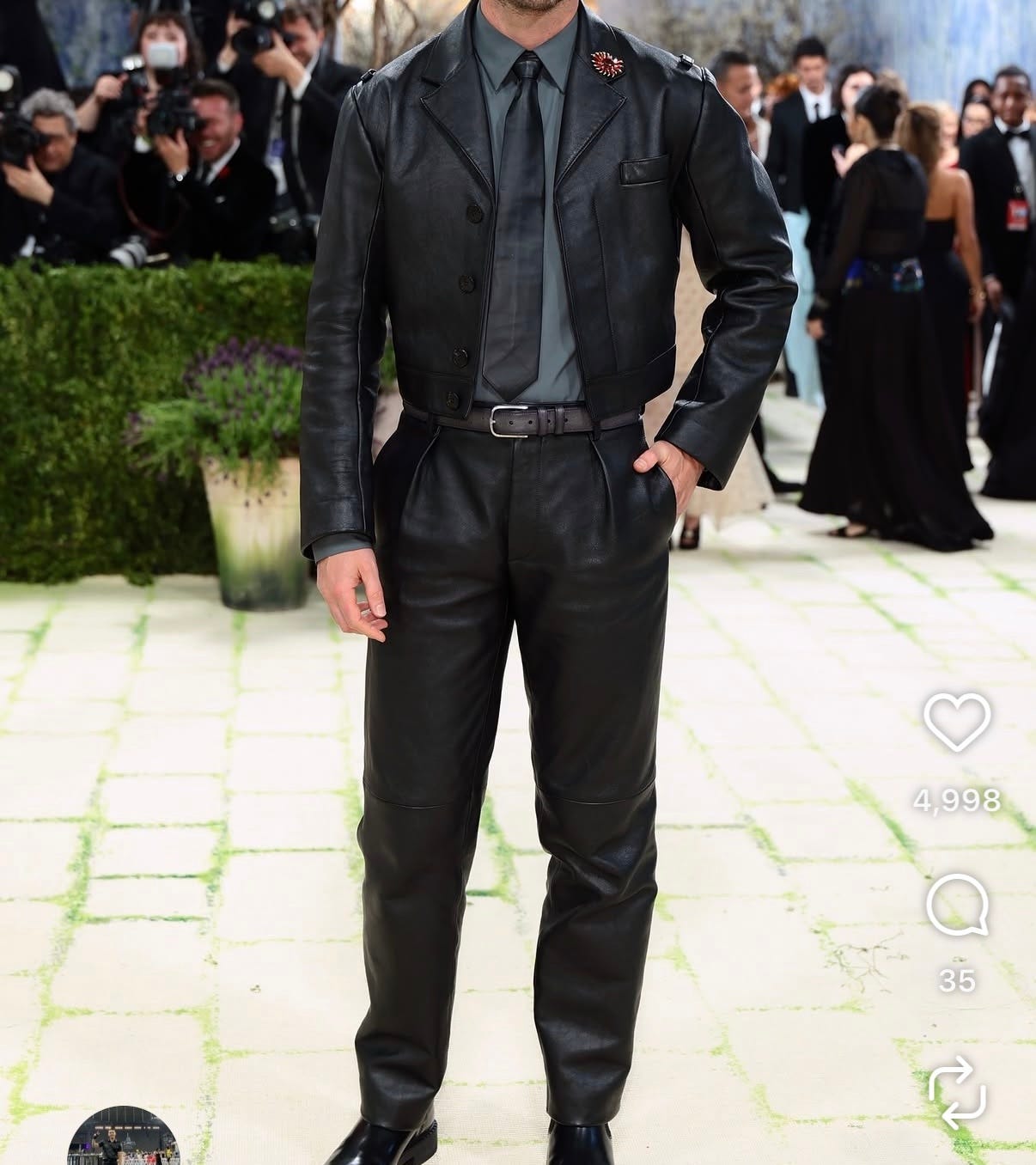
I intentionally cut off his head in the pic as an argument against “but he’s so good-looking that anything goes”. Look at the outfit itself without the distraction of his pretty face. The outfit still works. That’s the difference. Evans needs the Tom of Finland citation to explain what the outfit is doing. Hoult’s look is what Evans’s look is trying to be, without trying.
This look also proves leather is like stake — it’s really difficult to do it wrong if you simply don’t try too hard. To make a leather look so wrong that every aspect was off the mark is honestly an extraordinary achievement.
This is not anti-fashion. It’s anti-ignorance. Nobody is saying celebrities can’t wear leather as a fashion. We’re saying there’s a difference between wearing leather well and wearing a costume of leather culture while name-dropping its most iconic figure. Hoult respected the material. Evans performed the reference.
When I posted my reaction on Instagram — “I never felt so appropriate to say ‘my culture is not your costume’ before this” — the replies are in uniform:
“But he’s gay.”
“He’s gay, love.”
As if being gay grants automatic fluency in every subculture under the rainbow.
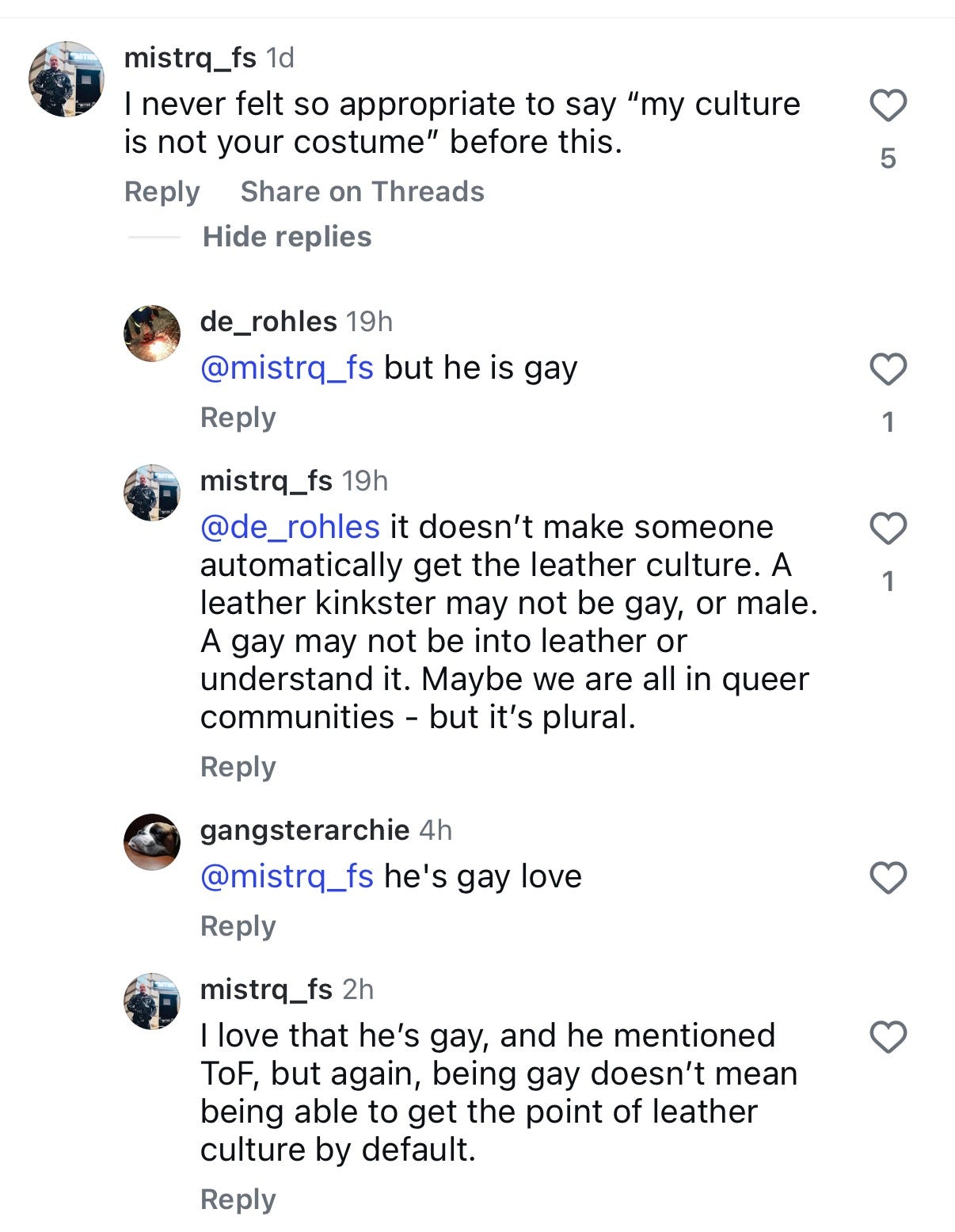
It doesn’t. A leather kinkster may not be gay, or male. A gay man may have zero understanding of leather culture. Maybe we are all in queer communities — but it’s plural. Being Chinese doesn’t make me an expert in all Asian cuisines. Being gay doesn’t make someone a leatherman. These are different cultures with different histories, different values, and different tastes. The umbrella keeps them dry from the same rain. It doesn’t make them the same thing.
And this is where it connects to something larger — something I’ve been thinking about for a while.
“Queer” is a word that has become so elastic that anyone with some personality can be called queer. “Inclusion” has become so reflexive that questioning anything about anyone under the umbrella gets you tagged as a gatekeeper. But when inclusion means anyone can reference any culture without understanding it — or an effort to, and criticism is deflected with “but he’s one of us,” inclusion has stopped being generous. It’s become a flattening mechanism. It doesn’t celebrate diversity — it dissolves it.
I’ve seen this play out in physical space. Walk through Folsom Berlin and you see a sea of black leather, among other serious fetish looks — gear with intention, codes with meaning, culture with weight. Walk through Folsom San Francisco and you increasingly see bare skin, harnesses as fashion accessories, jockstraps as party wear. Same event root. Different worlds. One preserves the identity. The other has become a Pride-adjacent street party where leather aesthetics get borrowed without the philosophy underneath. It’s now to the degree of sadness that I sometimes have to educate people coming to Berlin when they say to an American “you guys also have a Folsom event, right?” — “Yes, we do, Folsom is literally a street name in San Francisco, our version is original, BTW.”
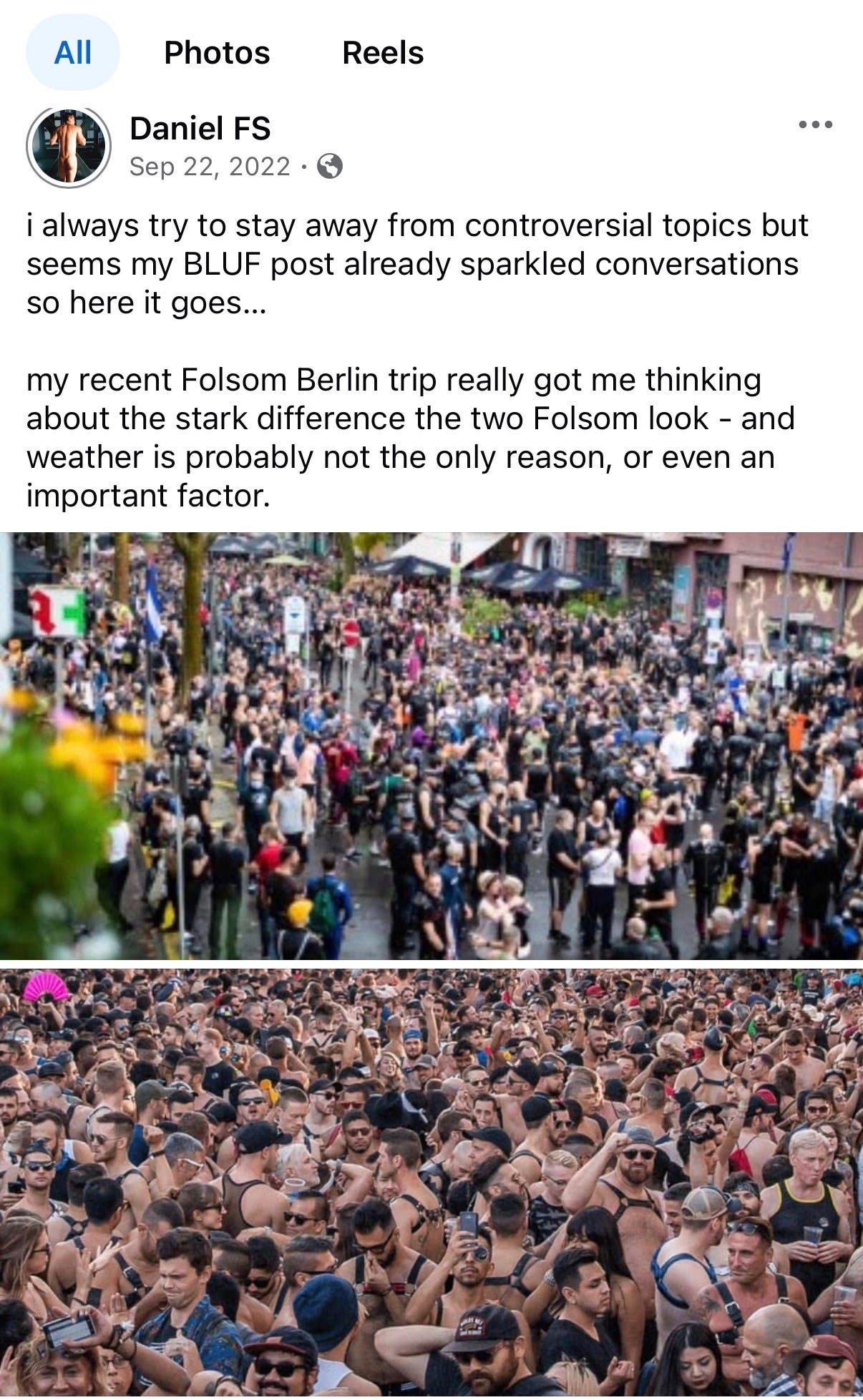
That’s not a complaint about who’s “allowed” to attend. It’s an observation about what happens when the distinction between doing something and being something collides — same as the scene-based people and lifestyle-based people collide in a kink civil war. When everyone is to be just everything, nothing means anything. When every reference is automatically valid because the person referencing it shares your broader identity category, you’ve replaced understanding with surface looks.
Leather culture was never just a wardrobe department. It grew through post-war biker masculinity, military surplus, motorcycle clubs, bars, backrooms, mentorship, codes, rituals, AIDS-era survival, fundraising, chosen family, and the long labor of making stigmatized desire livable. The Leather Archives & Museum exists precisely because this history was so often misunderstood, discarded, or erased. That is why the details matter. The look matters because it came from a whole world.
We need to be fair as well. Luke Evans mentioning Tom of Finland on the Met Gala carpet is exposure. It puts a name into mainstream conversation that most people outside the community have never heard. That has value — the same way Pillion sparked real discourse about power exchange in the mainstream, even as it made many kinksters uncomfortable. Visibility, even imperfect visibility, can open doors.
But exposure without comprehension is a double-edged sword. It introduces the faux aesthetic while stripping the meaning. It gives people a surface to react to while burying the substance that makes the culture worth knowing. And when the mainstream applauds the reference without noticing the execution is wrong — when the press calls it “leather daddy realness” despite it looking nothing like any leather daddy who has ever existed — then the exposure doesn’t educate. It replaces the real thing with a diluted, mainstream-friendly version and calls it representation.
The goal isn’t to gatekeep leather from the mainstream, or go back to an underground, secretive exclusivity. It’s to ask that when you invoke a culture — especially one built by marginalized people as a survival structure, forged in the aftermath of a world war by men who couldn’t fit back into traditional society, codified through decades of community struggles, ritual, and meaning against mainstream’s effort of erasure, compliance and silencing — you don’t bother doing the minimum homework. Talk to someone who lives it. Understand what black means, what the hardware means, what the silhouette means, what Tom of Finland was actually drawing and why. Or just wear leather as leather, the way Hoult did — without claiming an authority you haven’t earned.
If Evans or his designer had spent any quality time with any leatherman — even browsed the Tom of Finland books for more than five minutes — this outfit would not exist in this form. That effort would be respect.
Eventually, the problem is not that Evans wore bling-bling flared leather pants with a flat non-bulge, or gays wear harnesses and jockstraps as a won’t-go-wrong to every fetish and kink event. The problem is that the look asked to be read as leather culture while speaking almost none of its language. That’s classic culture appropriation by definition.
Leather itself is merely a material. Some people wear it as attitude, symbol, culture, history — armor against any force that wants to contain them. Some wear it as a costume to be thrown on the party floor whenever it’s not needed. We are not the same people. And that’s okay. That’s what diversity is about. Just please, don’t wear my culture as your costume.
Something resonates? Share it with others.
Subscribe for future writings.