
BED+D: Toward a Structural Theory of Power-Exchange Kink (Part 2/2)
Foundations, Philosophy, and the Human Cost: On the Right to Know Yourself, and to Live Authentically.

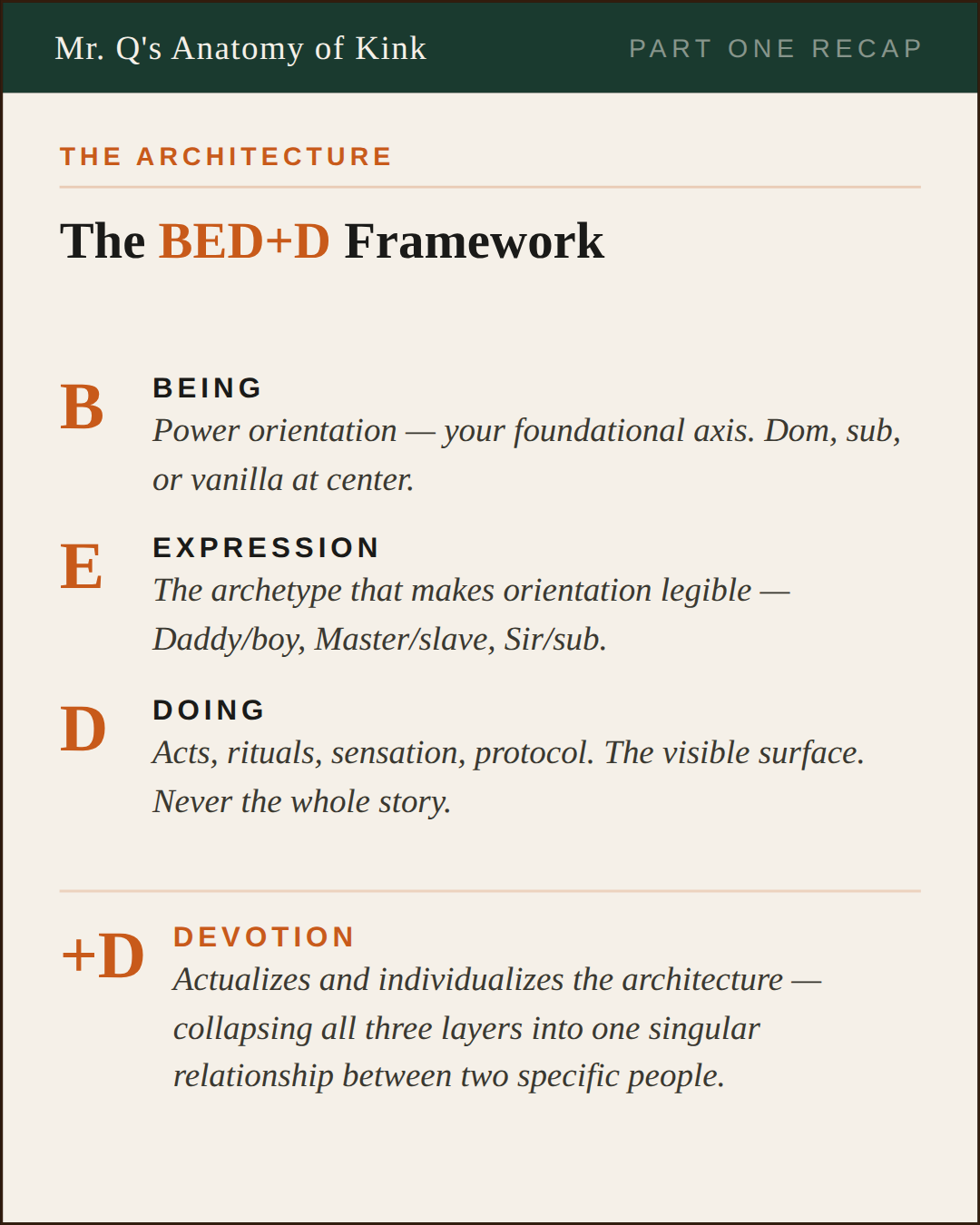
This is Part 2 of a two-part founding document. Part 1 introduced the BED+D framework — Being, Expression, Doing, and Devotion — and its practical applications. This part addresses the philosophical and political foundations, the question of where orientation comes from and how it is discovered, the quiet tragedy of Devotion arriving before architecture is legible, and what the framework makes possible personally and socially.
In this document, I am not using “kink” to mean every fetish or non-vanilla interest. I am concerned specifically with asymmetry-centered kink — the part of the kink umbrella defined in Part 1, where power itself becomes the organizing principle.
I. Power Is Already Everywhere
Michel Foucault argued, persuasively and with extensive historical grounding, that power is not a possession held by some people over others but a force that circulates through all social relationships. Power is present wherever two people interact. It shapes what is said and unsaid, who is heard and who is dismissed, who leads and who follows, whose needs are centered and whose are deferred. Or, as simple as, who loads the dishwasher after dinner.
This is not a radical claim. Anyone who has been in a long-term relationship, a workplace, a family, or a friendship recognizes it immediately. Power dynamics exist in all of them. They are negotiated, contested, shifted, and renegotiated constantly — usually without being named, usually under a shared virtual social concept that the relationship is between equals.
Vanilla relationships do not lack power dynamics. They organize power implicitly — through informal, ongoing, usually unacknowledged negotiation — while often maintaining the social fiction of equality even when influence, authority, and emotional leverage are unevenly distributed.
Power-exchange relationships do something different. They make power explicit and structural. Instead of applying the public social equality concept to their private life, participants deliberately construct hierarchy as part of the personal relationship itself. The asymmetry is named, symbolized, maintained, and given meaning. It is acknowledged rather than hidden.
The difference between a vanilla relationship and a power-exchange relationship is therefore not that one contains power and the other does not. It is that one treats power as fluid and implicitly negotiated while the other treats power as intentionally structured and symbolically real.
This reframing matters enormously for what follows. Kink is not a departure from normal human relational dynamics. It is a particular way of organizing something that is already universally present. The people who practice it are not doing something alien to human nature. They are being honest and consensual about a dimension of human relationships that most people prefer to leave unnamed as it looks incompatible with the norm of social equality.
II. Hierarchy Is Not the Deviation
This may be the most controversial claim in the framework, so it has to be stated clearly.
Hierarchy is not a deviation from the human default. Equality is the recent construction.
Dominance hierarchies appear in every human society ever documented, and in every closely related primate species. They predate civilization, predate language, predate any institution humans have built. The primate baseline involves power asymmetry, dominance, submission, rank, and the constant negotiation of position within hierarchy. These are not behaviors overlaid on a naturally flat species. They are features of what the species is — anthropologically as primal as basic survival needs.
Equality — in the specific sense of equal moral and legal status of persons, equal rights, equal standing before the law — is a remarkable moral achievement of modern civilization. It is also recent, contested, imperfectly realized, and maintained against significant social pressure rather than arising naturally from the species architecture. Equality is a moral aspiration and a political achievement built on top of a nature that does not default to it. It is good. It is also constructed.
To say equality is constructed is not to say it is false, weak, or optional. Some of civilization’s highest achievements are constructed. The point is not to demote equality, but to stop pretending that equality describes the full psychological reality of human intimacy. The fact that hierarchy is ancient does not make it morally sovereign; it only means that equality must be defended as an achievement rather than assumed as the natural state of intimate life.
Recognizing this changes how we understand people for whom power asymmetry is the organizing principle of intimate life. They are not people who failed to achieve the equality baseline. They are people who embrace a dimension of human nature that modern social ideology prefers to suppress — who experience the primal substrate of asymmetry in personal relationships not as something immoral to be overcome but as something to be organized around consciously, ethically, and with full acknowledgment of what it is.
Lifestyle kinksters do not reject social equality. They reject the notion that equality describes how human intimate relationships actually work. They choose instead to acknowledge the asymmetry that is present everywhere, to name it, to structure it deliberately, and to hold both parties accountable within that structure. In that sense, lifestyle kinksters are not less civilized than the vanilla person. They are simply refusing to pretend that intimacy is free of asymmetry.
III. Voluntary Hierarchy and Liberal Equality: A False Contradiction
The most common serious objection to power-exchange relationships is this: hierarchy within a relationship contradicts the equality principles that we hold as ethics. If you believe in equal rights and equal dignity, you cannot endorse relationships structured around dominance and submission.
This objection contains a category error. Once the error is identified, the supposed contradiction dissolves.
The objection conflates two different domains: civic equality and relational structure. These are not the same thing, and liberal political philosophy has never actually claimed they are. Liberal equality is a claim about legal and moral status — the equal standing of persons before the law, in the public sphere, in their capacity to enter and exit relationships. It is not and has never been a claim that all relationships must be internally symmetrical. Even more importantly, liberalism's defense of freedom of association actually cuts the other way.
Liberal society already endorses and legally protects a wide range of voluntary hierarchical structures: military command, religious vows of obedience, apprenticeship, mentorship, certain professional authority relationships. Nobody argues these contradict liberal equality — because everyone understands that what makes them legitimate is the voluntary nature of entry, the ongoing capacity to exit, and the equal civic standing that both parties retain outside the structure.
Power-exchange relationships are structurally identical in this respect. The submissive does not surrender their legal rights, their civic standing, or their moral status as a person — even if they want to. They organize their intimate life around a chosen hierarchy, and the choice is made possible precisely by the civic equality that gives them the standing to make it.
Liberal equality and voluntary hierarchy are not in tension. They are in a relationship of dependency. Equality is what makes voluntary hierarchy genuinely voluntary — and without equality, hierarchy would be imposed rather than chosen. Voluntary hierarchy becomes meaningful only where social equality is real enough to make refusal possible.
In a society without genuine equality — a caste system, a feudal structure, a slave society — people cannot meaningfully choose hierarchy or equality. The structure is imposed. The absence of meaningful choice is exactly what makes imposed hierarchy morally unacceptable. The moral force of the objection to slavery was never that hierarchy is wrong. It was that imposed hierarchy — hierarchy without genuine capacity to exit — violates the dignity of persons.
The right to exit is the moral hinge of voluntary hierarchy.
What distinguishes voluntary from imposed hierarchy is not the presence or absence of asymmetry — both have asymmetry. It is whether the person in the subordinate position retains genuine, realistic capacity to leave. Not merely formal permission — actual freedom, freedom from economic coercion, psychological manipulation, and social pressure that would make exit practically impossible even if theoretically permitted. The legitimacy of voluntary hierarchy depends on this condition being continuously met, not merely established at entry.
IV. The Terminology This Framework Requires
Structural theory needs precise language. The following terms can be used throughout BED+D with specific meanings, and the distinctions they mark are structural.
Voluntary hierarchy is a deliberately constructed asymmetric relationship in which both parties retain equal civic standing and genuine capacity to exit. It is distinguished from imposed hierarchy, in which one party’s position is determined by force, law, economic coercion, or social structure rather than choice. It is also distinguished from performative hierarchy, in which the asymmetry is bounded within a scene and both parties return to an equality baseline afterward. Voluntary hierarchy is ongoing, structurally real, and chosen — not performed and not imposed.
Devotional D/s is D/s organized around the relationship — around a specific person, an ongoing structure, and the meaning produced by sustained asymmetry. It does not end when the scene ends because it is not a scene — even though a lifestyle may not last life-long. It is a way of being oriented toward a specific other person. It is distinguished from recreational D/s, which is organized around the experience — the sensation, the intensity, the encounter — and is complete when the encounter is complete. Both are real. They are not the same thing, and the confusion between them produces some of the deepest mismatches in kink dynamics.
Recognized authority is the authority that arises from the specific person, from relational charge, from the quality of the dynamic itself — the authority that a genuine dominant carries not because it was pre-negotiated but because it is felt on both sides as real within the relational field. It is distinguished from negotiated authority, which is the authority explicitly granted through consent procedures and bounded by the terms of that negotiation. Recognized authority may precede negotiation psychologically, and in some sense exceeds it. This does not mean it operates without consent — it cannot legitimately bypass negotiation ethically. It means that in structures built on recognized authority, the consent is positional — an entry into a structure — rather than act-by-act, scene-by-scene. Recognized authority may explain why someone wants to enter a structure; it does not justify acting as if the structure exists before it has been mutually acknowledged.
V. How Orientation Forms: The Three-Source Model
BED+D describes what power orientation is and how asymmetry-centered kink is structured. The adjacent question — why some people carry deep power orientation and others do not — requires deeper dissection. This is the developmental question, and it demands a multi-causal framework rather than a single cause.
The framework proposed here identifies three interacting sources. None of them alone produces power orientation. Together they are not deterministic — the same combination of inputs can produce different outcomes depending on timing, circumstance, and the specific people encountered along the way.
The first source is innate predisposition.
Many people with deep power orientation, including myself, describe a felt sense of inevitability — a pull toward one side of asymmetry that predates any understanding of what kink is, any exposure to sexuality and pornography, any encounter with a specific person who activated it. This predisposition is not biological destiny. It may be better understood as a priming of the system toward particular responses: toward asymmetry, toward surrender, toward control, toward the specific quality of erotic charge that asymmetry produces.
The predisposition sets the initial orientation. It establishes what the system is primed to respond to. What it does not determine is how, or whether, that response develops into a conscious orientation, a relational identity, or a lived architecture.
The second source is cultural and developmental shaping.
An innate predisposition toward hierarchy meets a social world that will either give it language and form or force it underground. This is Gayle Rubin’s territory — the insight that desire does not come pre-labeled. The leather community, online kink content, a mentor who has been there before — these are not the source of the orientation. They are the source of the vocabulary, the archetypes, the practices, and the relational templates that allow an orientation to be recognizable and livable.
Someone predisposed toward submission may grow up in an environment that has no language for it, that reads it as weakness or pathology, that offers no community in which it makes sense. The predisposition does not disappear. It goes without form — present at the level of felt experience, absent at the level of legible identity.
The third source is personal trajectory and initiation.
Two people with similar predispositions and similar cultural exposure can arrive at entirely different places depending on who introduced them to power exchange, what their first dynamic was, whether that experience was formative or damaging, and — crucially — the story they tell about it afterward. The film Pillion is a perfect example of it — Colin may have a submissive predisposition, some exposure to biker culture and D/s intimacy in the bar, but his story could be a totally different one with different intensity and struggles from what he has with Ray.
The initiatory event is often the moment at which predisposition and cultural shaping converge into something that feels undeniably real — actualized with one real person. It may be a specific somebody whose presence activated something previously latent. It may be a community whose recognition made the orientation legible for the first time.
Early initiation can reinforce orientation, redirect it, or distort it. Someone whose first dynamic was exploitative may develop a confused relationship to their predisposition — either over-identifying with an imposed role or developing shame and avoidance around an orientation that is genuine. This is worth stating plainly: initiation is not morally neutral. Who introduces someone to power exchange, and how, has real consequences for the architecture that develops. This is one of the strongest arguments for community accountability structures and the mentorship tradition that Race Bannon’s work represents.
Put the three sources together:
Predisposition sets the direction. Culture provides the vocabulary. Initiation determines the trajectory — the path taken towards the possibility.
This is a multicausal model. It resists the false choice between “born this way” determinism and “it’s purely cultural construction.” The predisposition is real. The cultural shaping is real. The trajectory is real. None alone is sufficient. The orientation that emerges is the product of all three in interaction.
VI. The Discovery Pathway
The architecture as described runs from the inside out: Being at the foundation, Expression above it, Doing at the surface, Devotion as the force that actualizes everything. But nobody enters the architecture from the inside. Nobody arrives at kink with their orientation already named, their archetype already chosen, their dynamic already formed.
People enter through the only door available: experience.
The discovery pathway runs in the opposite direction from the structural architecture. It moves from outside in — from Doing toward Being, from enactment toward orientation, from the surface toward the foundation.
The first stage is entry through Doing.
Almost everyone begins at the behavioral layer. They encounter a sensation, a scene, a particular quality of headspace, an encounter that feels different from anything before it. The question is immediate and experiential: what is this? How do I like it? The question is not yet “who am I” or “what role fits me” or “what relationship structure do I want.”
This is why experimentation is not only normal but structurally necessary. It is the only available entry point. The person who “dabbles” in kink is not necessarily someone for whom kink will remain superficial — they may be someone at the beginning of a journey toward a much deeper architecture that they cannot yet see from the outside.
The second stage is the discovery of Expression.
While accumulating experience at the Doing layer, people begin noticing patterns in what they respond to. Certain dynamics feel different from certain acts. The bondage that was purely sensory feels different from the bondage that was about control. The scene that was playful feels different from the one in which something serious and hierarchical was present.
This is when archetypes begin to matter — not as labels to adopt but as recognition. When someone encounters a specific dynamic and feels something click into place rather than merely finding it interesting, the transition from Doing to Expression has begun.
The third stage is the recognition of Being.
Only after substantial experience do most people arrive at something deeper — a recognition that goes beyond preference or archetype. Certain positions feel not just comfortable but inevitable. The submissive orientation is not something chosen. It is something recognized, usually with a quality of retrospective coherence: earlier experiences, earlier feelings, earlier identifications begin to make sense in a way they didn’t before.
Expression can be tried on, adjusted, abandoned. Being cannot. When someone recognizes their orientation — not as a preference but as a structural fact about themselves — it has a quality of discovery rather than decision. They are not choosing what they are. They are seeing what they already were.
This is also the stage with the most struggle when the social equality norms conflict with what asymmetry implies, especially when the orientation seems not something they can change but have to choose to embrace or deny. Many people never make that leap.
Then there is the arrival of Devotion that can happen at any stage.
Just like any relationship, it requires the right specific person to be present, and that person does not arrive on demand. It is even rarer given how small the pool may be of people who can complement you from the opposite side of the power orientation Being axis.
Devotion is not the recognition of what you are. It is the recognition of who calls what you are into its fullest expression. A person can know their orientation with complete clarity and still not have found the person in relation to whom that orientation becomes real rather than potential.
The symmetry this reveals:
The structural architecture runs: Being → Expression → Doing;
The discovery pathway runs: Doing → Expression → Being.
Devotion is what actualizes the whole into a singular relationship between specific individuals.
The directions are exactly opposite. The structure as it exists and the structure as it is experienced run in reverse. This tells us why people misidentify their orientation early in their journey — because they are at the outer layers, without access yet to the inner ones.
Someone who has only reached Expression may identify as a switch because they have discovered role versatility before they have recognized a home base on power orientation. Someone who has only reached Doing may believe they are scene-based when the architecture is much deeper and the right person simply hasn’t appeared yet.
The discovery pathway is the most common route. Real life never happens as clean as the theoretical architecture shows, and the route is not the only one. Some people encounter Devotion before their orientation is named — a specific person arrives and the relationship itself becomes the initiatory experience that accelerates the entire inward journey. Devotion arrives early and drags Being and Expression into visibility in its wake. It's exactly what happens to Colin when meeting Ray — which is why some viewers find it alarming, though that discomfort may say more about the framework they're using than about what's actually happening between them.
VII. The Tragedy of Devotion Before Architectural Recognition
Devotion does not wait for the architecture to be complete. It arrives when it arrives.
And for many deep Beings — people whose power orientation sits far from the equality-based center on the Being axis, Devotion often arrives before the discovery journey is complete — before they have language for what they are, before they have encountered community that would give them archetypes, before they have recognized the depth of their own orientation. It arrives during a period of maximum orientation ignorance and minimum community access, and it anchors itself to a person whose BED-frame cannot hold the full weight of what deep Beings need.
This is not a personal failure on anyone’s part. It is a structural condition. And it is one of the most common quiet tragedies in the lives of people who carry deep power orientation into a world that has no awareness for what they are.
The three flavors of dilemma
The discovered-late dilemma. Someone in a long-term vanilla devotional relationship encounters kink. They suddenly have language for what they have always been. They recognize their deep orientation for the first time. The relationship they are in cannot hold it. The Devotion is real and binding — only it’s with a vanilla partner. The Being is existentially real as well.
The suppressed-orientation dilemma. Someone knows at some level what they are but suppresses it — because of shame of being “abnormal”, because of cultural messaging, because they tell themselves it is just fantasy in porn, because they think the heteronormative vanilla lifestyle is the only respectable and possible one, because the Devotion they feel toward a vanilla partner feels more important than power orientation. They build a life. The suppressed Being does not disappear. It surfaces eventually — through dissatisfaction, through compulsive behavior, through a crisis that the vanilla partner cannot understand because they never knew the full architecture of the person they love.
The partial-expression dilemma. The couple negotiates some kink expression within the relationship — occasional scenes, some power dynamic elements, a degree of openness. Often the one with the deeper orientation tries to gradually introduce their partner to dynamics they need, to some degree of success. It is better than nothing. But it is not enough. The partner with the deeper orientation lives in a permanent condition of partial satisfaction — enough to stay, not enough to feel whole. A potential risk is these needs bleed into the aspects of a relationship that should better fall into the social equality domain.
Why the open or poly relationship solution is insufficient
Instead of suppressed or partial power dynamics inside their relationship, some people choose to open it up so the Being one is permitted — often more “tolerated” than encouraged — to explore and find fulfillment out of the devotional relationship. The architecture gets split across relationships. It works for some people sometimes.
But Devotion is not layer-specific. The exclusivity of some power dynamics is real. It cannot be divided neatly between partners — vanilla Devotion here, kink expression there. Because Devotion is the force that singularizes and actualizes the entire architecture, a deep Being who carries Devotion toward a vanilla partner will find that their kink expression with others — however satisfying at the Doing or Expression level — remains architecturally incomplete, foundationally unfulfilled. The solution that was supposed to solve the problem has formalized it instead.
What is missing is not more acts or better archetypes. What is missing is a partner toward whom Devotion and Being-level orientation can be directed simultaneously. This is not a claim that all Devotion must be monogamous or singular in a conventional romantic sense. It is a claim that some power orientations require a specific alignment between Devotion and power structure that cannot be satisfied by separating emotional bond from kink expression. The limitation of open or poly arrangements, in these cases, is not a failure of goodwill or creative relationship design. It is a structural condition that no arrangement fully resolves when Devotion has already been anchored in the less ideal place.
The systemic dimension
This tragedy is not accidental. It is produced by the charmed circle Rubin described. The cultural hierarchy of sexual legitimacy ensures that people with deep power orientation grow up without vocabulary, without role models, without community. They form their first devotional bonds in the vanilla world — the only world available to them at the moment when Devotion first arrives.
The tragedy is not just personal. It is systemic. I know the dilemmas are real; I was in more than one of those at different stages of my life. I witness them every day.
VIII. The Case for Early Awareness and Destigmatization
If the tragedy of Devotion before architectural recognition is systemic rather than personal, the response must also be systemic rather than purely personal.
The usual political argument for kink acceptance runs like this: consenting adults should be free to do what they choose. That is correct and necessary. But BED+D makes a deeper argument — one that no existing framework can make because none of them has the architecture to explain why early awareness matters structurally rather than merely personally.
The argument is about lifetime happiness and fulfillment: people with deep power orientation deserve to know what they are before Devotion commits them irrevocably.
Someone who grows up with language for power orientation — who encounters community, role models, the vocabulary of Being and Expression, the understanding that their orientation is real and not pathological — is far less likely to anchor their Devotion in a structure that cannot fulfill them — or more equipped to be intentional about how to organize their lives, kink or not. They can make informed choices about who they form bonds with, about what architecture they need from a relationship, about what level of expression is sufficient and what level of suppression is sustainable.
Someone who grows up without that awareness makes those choices blind. And Devotion, arriving blind, anchors in the available structure rather than the right one.
Destigmatization work and kink education are therefore not just about tolerance or rights. They are about lifetime happiness based on the conditions of self-knowledge. They are about ensuring that the most powerful relational force in the framework — Devotion — arrives in a person who knows enough about their own architecture to direct it well.
This reframes what we are asking for when we argue for kink acceptance. We are not merely asking for the freedom to practice. We are asking for the cultural conditions in which people can know themselves clearly enough to practice wisely — to understand their orientation before they have committed their most irreversible attachments, to find community before they have spent decades suppressing what they are, to have the vocabulary for their architecture before Devotion makes the question urgent — so that they have the right BED-frame to make their own BED, find their compatible big D, and sleep happily in it.
The charmed circle does not just exclude kink from legitimacy. It ensures that the exclusion does its worst damage at the worst possible moment — when a young person with a deep power orientation is forming their first serious bonds, and has no framework for understanding why the available templates feel like wearing someone else’s clothes.
Education and destigmatization are not peripheral to this framework. They are its social implication. The theory is much less impactful without them.
The early awareness and self-knowledge is also about harm reduction.
Just like consent needs to be informed, the choice of a kink lifestyle also needs to be informed. This is ultimately about harm reduction — and the harms are more concrete than they might appear.
Some submissives, without fully understanding their orientation and without being intentional about where it belongs, may allow their submissiveness to bleed beyond the relational architecture into the social fabric of their lives. Without the framework to distinguish devotional submission from general deference, they can become structurally vulnerable — attracting people who recognize the compliance without recognizing the person. The harm is not only emotional. It can be social, financial, and reputational. Takers — people who extract without reciprocating responsibility — find undefended submissives easy targets precisely because the submissive hasn’t yet named what they are and built the appropriate boundaries around it.
Architectural self-knowledge changes this. A submissive who understands their own BED structure knows that submission is not a personality trait to be exploited in every context — it is a relational force to be directed intentionally, toward a specific person who can hold it properly instead of abusing it, within a structure that carries mutual responsibility. That understanding is protective. It enables them to establish the right boundaries in the right places — offering depth where depth is warranted, and withholding it where it is not.
The orientation doesn’t make someone vulnerable. The lack of language for it does.
IX. What Makes Power Exchange Legitimate
The case for destigmatization rests on a prior claim: that power exchange, when practiced well, is genuinely legitimate — not merely tolerated, but worthy of recognition on its own terms. That question deserves a direct answer.
So what makes power exchange legitimate to be recognized and destigmatized? Most existing frameworks answer the question of legitimacy at the Doing layer. SSC — safe, sane, consensual — is a behavioral checklist. RACK — risk-aware consensual kink — is a more sophisticated behavioral framework. Both locate legitimacy in the properties of acts and the procedures surrounding them.
BED+D locates legitimacy somewhere else. Not instead of procedure — in addition to it, and going further.
The question this framework asks is not only “were the acts consented to” but “what kind of relationship is this?” What does it produce for the people in it? What responsibilities does it generate, and are they being carried?
A power-exchange relationship achieves genuine legitimacy through four conditions, all of which must be present simultaneously.
Bonding — genuine attachment, not performed connection.
The relationship involves real emotional investment from both parties. The specific other person matters in a way that is not interchangeable. Without bonding, the structure may be technically consensual but relationally hollow. Procedural correctness cannot substitute for genuine attachment as the foundation of a legitimate dynamic.
Commitment — structure that persists and shapes behavior.
The relationship has duration and continuity that extend beyond any individual encounter. Both parties are oriented toward it as an ongoing structure rather than a bounded event. Commitment is what distinguishes lifestyle dynamics from casual play — not the intensity of what happens but whether the relationship has a shape that persists and influences how both people actually live.
Mutual benefit — recognizable value for both parties, asymmetrically distributed.
Both parties experience the relationship as genuinely enriching rather than depleting. This does not mean symmetrical benefit — the dominant and submissive are not receiving the same things. What mutual benefit requires is that each receives something the structure makes possible that matters genuinely and would be difficult to find elsewhere. The contrast is with extractive dynamics — those in which benefit flows substantially in one direction over time. Both parties have to be genuinely fed by the structure, not merely tolerated within it.
Responsibility — recognized authority accompanied by accountability.
Authority without responsibility becomes exploitation. The dominant who takes without giving genuine care — who claims the submissive’s service, obedience, and surrender without taking serious responsibility for what that costs — is not exercising legitimate authority. They are extracting under the cover of a role.
Responsibility without authority becomes martyrdom. The submissive who gives without the reality of hierarchy being held by the other side is not in a power exchange. They are in a relationship where the language of power is present but the architecture is absent.
Legitimate power exchange requires both simultaneously and continuously. This is a more demanding standard than any consent checklist — and it is the standard that the deepest power-exchange relationships actually require.
Existential fulfillment as the ultimate criterion
Beneath all four conditions sits the continuing right to exit. Without that, bonding becomes captivity, commitment becomes entrapment, mutual benefit becomes rationalization, and responsibility becomes exploitation.
Beyond these four conditions lies the deepest criterion. For some people, power exchange is not merely erotic or relational. It is existential. The dynamic is where they most fully become who they are — where Being, Expression, Doing, and Devotion align in a way that produces something that can only be described as living authentically.
This is what Bataille was gesturing at when he placed erotic experience in the category of encounters that exceed the ordinary boundaries of self. For those people, a power-exchange relationship that produces this kind of existential fulfillment cannot be adequately judged by a behavioral checklist. The checklist regulates acts. Existential fulfillment is not an act. It is a way of being organized — a way of living closer to the truth of what one is.
The full legitimacy claim:
A power-exchange relationship achieves legitimacy not through procedure alone but through a structure of genuine bonding, sustained commitment, mutual benefit asymmetrically distributed, and real responsibility carried on both sides — a structure that, at its fullest, becomes a path toward existential fulfillment for both parties. The hierarchy is legitimate not merely because it was agreed to but because it is real, reciprocal, and productive of genuine human flourishing.
X. What Remains Unresolved
A framework that claims to answer everything is not credible. These two articles about BED+D together form a founding document, not a final one. The following are not misses of the framework — they are the map of the work it opens.
The expandability of this framework — The relationship between asymmetry-centered kink and fetish-centered or sensation-centered kink. My readers are sharp. In the comments under Part 1, some already noticed that the framework may extend beyond power-exchange kink; one even said it may be “95% of the way” to explaining fetish and non-power kink too.
The place of switch and role versatility within the architecture — It’s one of the evergreen debates in the kink community. Is it true that switch does not exist (on Being axis), and only switching exists on the Expression and Doing layers? Does every asymmetry-centered kinkster always have a natural-leaning side on the Being axis? We may need more field research about it. Switch-identified people may be among the most structurally flexible participants in power exchange, and also among the most easily misunderstood by binary models.
The developmental origins layer — the full account of how biological predisposition, cultural shaping, and personal trajectory interact to produce power orientation at different depths — is sketched here and requires substantially more development. In particular, the relationship between complex developmental trauma and power orientation deserves careful, non-pathologizing treatment: the argument that trauma can shape the urgency with which someone needs to live inside an asymmetric structure without the orientation itself being reducible to trauma.
The social and community architecture layer — what communities, accountability structures, mentorship traditions, and cultural institutions are required to make deep power exchange sustainable and ethically held — is identified throughout but not fully developed. This is the layer that explains why lifestyle kink requires community infrastructure in a way scene-based kink does not, and why the absence of community accountability produces specific and predictable harms.
The full development of the Doing layer — empirical work mapping how specific practices cluster within the sensation-power quadrant, and what those clusters reveal about the distribution of orientations within the broader kink community — awaits the kind of systematic survey methodology that researchers like Aella have begun to make available.
The question of dominant and submissive asymmetry — whether the two poles of the power orientation axis are perfectly symmetrical in their structure, their developmental origins, and their relationship to vulnerability — is assumed here but not argued. There are reasons to suspect they are not symmetrical, and those reasons deserve examination.
The application of BED+D across diverse subcultural contexts — queer and straight, monogamous and polyamorous, different generational cohorts, different racial and cultural communities — is gestured at but not performed. A structural theory should account for how the same architecture manifests differently across different social locations.
These are the frontiers. The work continues.
XI. Conclusion
The central question of power-exchange kink is actually:
What becomes possible between you?
The architecture — Being, Expression, Doing, and Devotion — gives people language for what they are, at what depth, through what forms, in what enactments, and through what singular relational force. It distinguishes the layers that have too long been collapsed into one. It explains why the same act means different things, why the same orientation expresses differently, why the same dynamic feels categorically different with different people.
But architecture is not relationship. Architecture describes possibility. What becomes possible between two specific people — whether Devotion arrives, whether the structure becomes real rather than potential, whether the dynamic produces something that neither person could have found elsewhere — is never something the framework can predict or guarantee.
That is just honesty about what relational life actually is. Structure can be understood. Devotion cannot be engineered. The first clarifies. The second arrives, or it does not.
What BED+D makes possible is: people might arrive at the moment when Devotion could arrive knowing what they are, having found the forms that fit them, having built the Doing that makes their orientation legible in the body. That they might offer themselves to another person not as a mystery they cannot name but as an architecture clearly understood — a foundation solid enough that whatever Devotion decides to build on it will not easily fall apart from lack of self-knowledge.
The framework is not the relationship. But it might be what makes the right relationship more attainable.
What are you?
Being, Expression, Doing — the architecture is there to be known.
What becomes possible between you?
That is the question only Devotion can answer — more reliably with proper knowledge of our own architecture.
References
Arendt, H. (1970). On Violence. Harcourt.
Bataille, G. (1957/1962). Erotism: Death and Sensuality. (M. Dalwood, Trans.) City Lights Books.
Bannon, R. (1992). Learning the Ropes: A Basic Guide to Safe and Fun S/M Lovemaking. Daedalus Publishing Company.
Foucault, M. (1978). The History of Sexuality, Volume 1: An Introduction. (R. Hurley, Trans.) Pantheon Books.
Mint, P. (2007). Towards a general theory of BDSM and power. Freaksexual.https://freaksexual.com/2007/06/11/towards-a-general-theory-of-bdsm-and-power/
Rubin, G. (1984). Thinking sex: Notes for a radical theory of the politics of sexuality. In C. Vance (Ed.), Pleasure and Danger: Exploring Female Sexuality (pp. 267–319). Routledge & Kegan Paul.
Aella. (2025). The other sexual orientation. Knowingless.
