

I. What This Is — And What It Isn’t
In my earlier piece Kink Civil War, I drew a distinction among kinksters that resonated with a lot of people:
Scene-based: “Kink is what I do.”
Lifestyle/Identity-based: “Kink is what I am.”
That distinction gave people language to recognize their positioning in the community — and the debates that follow from that positioning. It was a useful first cut. But it was also, deliberately, an over-simplified one. It didn’t answer the deeper questions it implied. Why are we who we are? What determines which side of that line someone falls on, and at what depth? What about switches — where do they sit in a binary that seems to have no place for them? And what actually separates two people who both say “kink is what I am” but inhabit completely different relational realities?
Since then I’ve been developing my thinking. This is my result.
This is not advice. It is not a memoir. It is not a consent guide, a community manifesto, or a defense of kink against its critics. It is not sex-positive activism, though I am all for that project. It is not academic sociology, though it draws on theory. It is not the wisdom tradition of the Old Guard, though I respect that lineage and am in conversation with it.
This is an attempt at structural theory.
That matters, because almost no one tries to do this. When people write seriously about kink, they tend to fall into one of four modes.
The first is community etiquette — safe, sane, consensual culture, negotiation frameworks, risk-awareness education. Valuable, necessary, and focused almost entirely on the behavioral surface.
The second is personal narrative — the “my D/s journey” essay, the memoir of discovery, the account of a specific dynamic. Honest and often moving, but particular where theory needs to be general.
The third is academic sociology — researchers, usually outsiders, interviewing kinksters, coding themes, publishing in journals that most practitioners never read. Rigorous in method, often thin in understanding, because lived architecture does not fully reveal itself to observation from outside.
The fourth is sex-positive activism — the argument that kink is valid and kinksters deserve rights and dignity. True, and important politically, but activism simplifies language by necessity, and simplification is the enemy of structural understanding.
What very few people attempt is the question underneath all of it: why does this exist in the form it takes? What is the structure? What are its layers, and how do they relate? Why do two people doing what appears to be the same thing inhabit completely different relational architectures? Why does the same act mean something entirely different depending on who is doing it and what organizes the encounter?
Those are theoretical questions. They require a theoretical framework to answer.
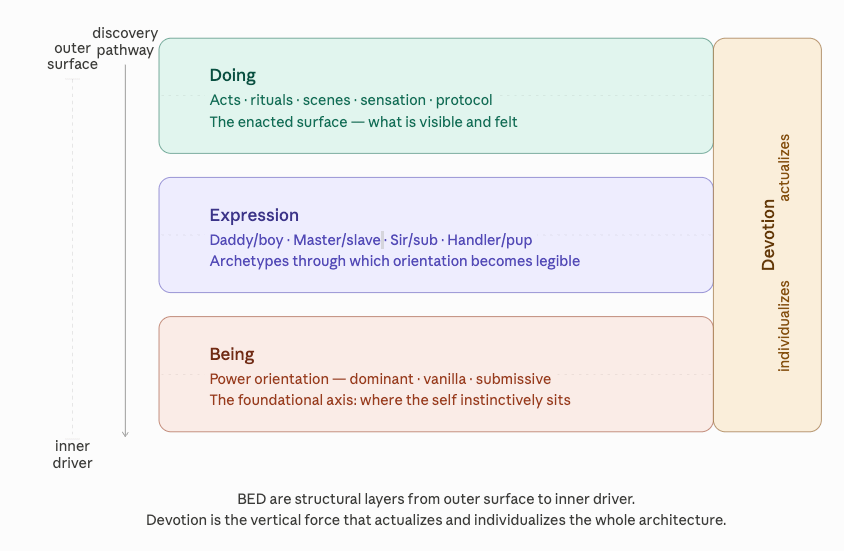
The framework I am proposing is called BED+D: Being - Expression - Doing, and Devotion. The name is a joke. The framework is not.
I bring to this project something genuinely uncommon: analytical training from a career in data and system architecture, thirty years of lived experience across kink subcultures, exposure to leather culture, festival culture, film discourse, and online kink communities across multiple generations, and the ability to write reflective essays without requiring a disclaimer before every sentence. I am not a researcher observing kink from outside and theorizing inward. I am someone who has lived the architecture being theorized, with enough distance now to build the scaffold around it.
Most sexuality academics observe, interview, and theorize. Very few have inhabited multi-year power-exchange structures as a primary relational mode. That combination of analytical and embodied positions — theoretical and lived — is the unusual vantage point from which this framework emerges.
I know it’s ambitious for a new writer — and I will be wrong about some things. The framework is incomplete by design — I will name what it does not yet answer. But I believe it is more structurally precise than anything currently available, and I am writing it because that precision matters: to the people who have lived these dynamics without adequate language for them, to the communities trying to understand themselves, and to the broader cultural conversation about what power, intimacy, and human hierarchy actually are.
II. The Problem: Existing Frameworks Flatten Things
Since late 2025, the film Pillion has generated one of the most revealing and ongoing arguments the kink community has had in recent memory. The film depicts a power-exchange relationship between two men — one dominant, one submissive — with little explicit negotiation, considerable emotional distance from the dominant, and an ending that refuses easy resolution.
People who watched it arrived at completely opposite moral conclusions. Some found it disturbing — a depiction of coercion, grooming, and abuse. Others found it deeply recognizable — an honest portrait of how a lifestyle power exchange actually operates, including its costs and its particular beauty.
What struck me, watching the argument unfold, was that both groups were not simply disagreeing about a film. They were operating from different premises about what kink fundamentally is. The same scenes, processed through different frameworks, generated different moral readings not because one group was more ethical or more perceptive, but because they were applying incompatible architectures to the same material.
This is the problem that structural theory exists to solve.
When people disagree about what kink is — whether a specific dynamic is abuse or devotion, whether a specific relationship is exploitative or legitimate, whether a specific film is harmful or honest — they are rarely disagreeing at the level of facts. They are disagreeing at the level of ontology: different conceptions of the structure of kink itself. Without a shared structural framework, those disagreements cannot be resolved. They can only be repeated, escalating into the kind of community infighting that mistakes philosophical difference for moral failure.
BED+D is an attempt to provide that structural framework. Not to end disagreement — genuine disagreement at the philosophical level is productive and should continue. But to make the disagreement legible: to show people what they are actually disagreeing about, and why.
III. Kink Is an Umbrella, Not One Thing
Before the architecture can be built, one prior question needs settling — and most kink discourse skips it entirely.
Kink is not one thing. It is an umbrella term for sexual and relational formations that depart from vanilla norms. Under that umbrella, there are at least three distinct organizing logics, and conflating them produces the confusion that makes so many kink debates unresolvable.
Fetish-centered kink is organized around objects, materials, body parts, or symbols. The erotic charge comes from the specific thing — leather, rubber, feet, uniforms, particular textures or smells. Power may or may not be present. Often it is not the point.
Sensation-centered kink is organized around bodily intensity. Impact, restraint, pain, altered states, sensory deprivation — the charge comes from what the body experiences. Again, power may or may not be present. Some of the most intense sensation play involves no meaningful power dynamic at all.
Asymmetry-centered kink is organized around power imbalance itself. Authority, surrender, hierarchy, control, obedience, service — the charge comes from the relational structure, not primarily from the acts or the sensations they produce. The acts matter, but they are downstream from the asymmetry that gives them meaning.
These categories overlap constantly in the same person and the same scene. Most practitioners draw from more than one. But they are not identical, and they are not organized by the same principle. Treating them as one thing produces the specific confusion where a scene-based practitioner and a lifestyle practitioner look at the same act and see completely different things — because they are, in fact, seeing different things. The act is the same. The organizing architecture is not.
BED+D is primarily a theory of asymmetry-centered kink. It concerns the forms of kink in which power imbalance is the deepest organizing principle — where hierarchy is not the context for the erotic experience but the substance of it. If your relationship to kink is primarily about sensation or fetish with no particular power dimension, this framework is not your home address. If the hierarchy is the point, read on.
IV. The Intellectual Lineage
BED+D does not emerge from nowhere. It sits at the intersection of several bodies of serious thought, and situating it there is not academic credentialing. It is showing where the framework’s roots run and where it departs from its predecessors.
Foucault established that power is relational and productive rather than merely repressive — not something imposed from above onto passive subjects but something that circulates through relationships and is actively taken up by the people within them. The submissive who chooses submission is not simply subjected to power; they are participating in its production. This insight is foundational to BED+D’s account of voluntary hierarchy. But Foucault does not explain why specific people orient toward specific poles of asymmetry, or what the architecture of that orientation looks like. That is where this framework begins.
Hannah Arendt drew a precise and underused distinction between power and violence. Power, for Arendt, is constituted relationally and depends on the ongoing recognition and participation of both parties. The moment that recognition is withdrawn, power collapses. This maps onto the legitimacy structure of power exchange as BED+D understands it: a dominant’s authority is not a possession they hold and deploy. It is a quality of the specific relationship between this dominant and this submissive, co-constituted and sustained by both parties’ ongoing investment in the structure. Arendt was writing about collective political power; I am extending her insight to intimate relational structures, an extension I make explicitly rather than silently.
Georges Bataille understood eroticism as the domain in which the boundaries of the self are deliberately suspended — where the ordinary separateness of persons yields to something that exceeds it. His 1957 work Erotism: Death and Sensuality illuminates what happens at the deepest levels of power exchange, particularly when Devotion is present: the self becomes organized around the other in a way that reorganizes it. Bataille helps explain why practitioners often describe their deepest dynamics in language that sounds almost mystical — because the experience genuinely exceeds ordinary relational categories.
Gayle Rubin is essential. Her 1984 essay “Thinking Sex” remains the foundational academic legitimation of kink as a valid sexuality rather than a pathology. Her concept of the “charmed circle” — the hierarchy of sexual legitimacy that places vanilla monogamous heterosexual sex at the center and everything else progressively further out — provides the political context within which BED+D operates. BED+D extends her project by providing the structural account of what sits beyond the circle’s edge.
Race Bannon represents the practitioner-intellectual lineage within the leather and BDSM community itself — my biggest inspiration. His work, including Learning the Ropes (Daedalus Publishing Company, 1992), belongs to a tradition of serious thinking from inside the community about what these relationships are, what they require, and what ethics looks like when you take them seriously on their own terms. BED+D is in conversation with that tradition — an attempt to provide the theoretical scaffold that tradition has always gestured toward but rarely built explicitly.
Finally, Pepper Mint’s 2007 practitioner-theory essay “Towards a General Theory of BDSM and Power” attempted something similar in spirit, asking what BDSM does with cultural power. His insight — that the archetypes of Expression are borrowed and transformed from the nonconsensual power dynamics of the wider culture through a “detachment operation” — is accurate and valuable. Daddy/boy, Master/slave, handler/pup: none of these were invented from scratch. They were taken from cultural power relations, stripped from their original coercive contexts, and repurposed as consensual relational forms. BED+D begins where his analysis ends: at the internal architecture of orientation and the dyadic relationship, rather than at the political relationship between kink and mainstream power.
V. The Deepest Driver Is Not Sensation
Here is the first major claim of the framework, and the one that departs most sharply from common views of kink.
Most people, asked to explain what makes kink different from vanilla sex, reach for sensation. More intensity. More extremity. Higher chemical response. A bigger hit of whatever the body releases when pushed past ordinary limits. This is true for sensation-centered kink, and it describes something real. But for asymmetry-centered kink — for power exchange in the fullest sense — it is a category error.
The deepest layer is not sensation.
The deepest layer is power orientation.
Power orientation is not a preference, a taste, or a sexual interest among others. It is the structural fact of which side of asymmetry a person instinctively inhabits — where they put themselves when they encounter power, hierarchy, authority, surrender, control, or command. It is the answer to the question: when you see dominance, do you experience yourself as the one who imposes or the one who receives? When you imagine hierarchy, where do you stand in it?
This orientation is often felt before sexuality fully develops. Children who identify with the position of authority in film narratives, myth, disciplinary encounters, or fantasy — not with the sensation those scenes produce but with the position in the power relation — are already showing something at this layer. The orientation precedes the act. It precedes the scene. In many cases it precedes any understanding of what kink is.
The empirical evidence supports this. Sex researcher Aella, working with survey data from over 80,000 respondents, found that people who reported BDSM-related interest beginning at age five or earlier were the most intensely oriented toward it — well before any exposure to pornography or sexual content of any kind. Age of onset correlates with intensity of orientation. That is exactly what you would expect if power orientation is foundational rather than acquired. My own childhood experiences also validate this.
Sensation is not unimportant. It is one of the primary ways that power becomes legible in the body — one of the main channels through which asymmetry becomes real rather than merely conceptual. But sensation is downstream from orientation. It belongs to the layer of enactment, not the layer of foundation.
The same act — a hand around a throat, a person on their knees, a set of rules followed without question — can mean entirely different things depending on what organizes the encounter. With some people, it is a sensation experience with a power aesthetic. With others, it is an expression of something that goes all the way down to the structural core of who they are. The act cannot tell you which. Only the architecture can.
The gradient of power preference-orientation
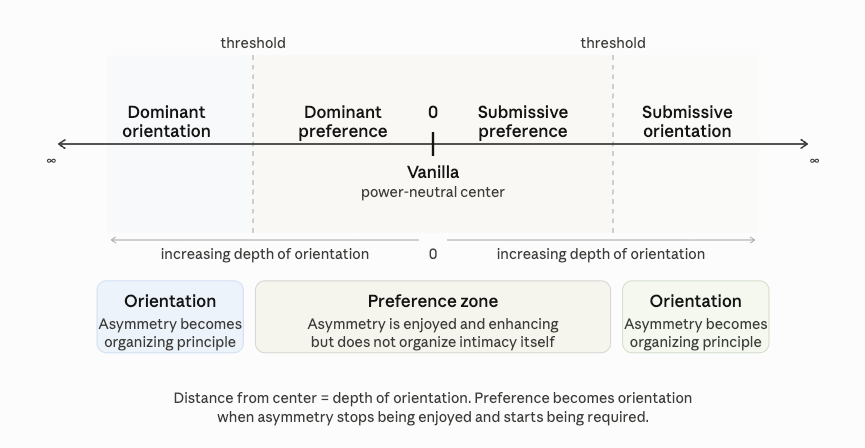
Not all power orientation is equal in its grip. The framework allows for depth variation rather than forcing everyone into a single category.
Within the preference zone: asymmetry is pleasurable, enhancing, interesting. A person here enjoys power exchange, may seek it out, but could live a complete erotic and relational life without it. The preference is real but not organizing.
At the orientation ends: asymmetry is structurally necessary. A person with a deep submissive or dominant orientation does not merely enjoy power exchange — they require it for intimacy to feel fully real. Vanilla sex may be possible, even pleasant, but it does not produce the same depth of experience. The orientation organizes how intimacy works for this person, not just what they prefer within it.
The preference becomes an orientation when asymmetry ceases to be merely enjoyed and becomes part of how intimacy itself is organized. That threshold is fuzzy but real, and crossing it changes the structure of what a person needs from their relationships.
VI. The Axis: At the Center is Vanilla, Not Switch
Power orientation sits on a complementary bipolar axis.
One pole is dominant orientation. The other is submissive orientation. The center is not switch.
The center is vanilla (Power-Neutral): an equality-based relational orientation in which power asymmetry holds little structural meaning. A person at the center may enjoy many kinds of sex, may experiment with power aesthetics, may find scenes interesting. But the relationship itself is not organized by hierarchy, surrender, or authority. That is what the center represents — not both poles simultaneously, but neither: genuine neutrality toward asymmetry as an organizing principle.
This distinction matters because the most persistent confusion in kink taxonomy comes from mapping the dominant/submissive axis onto the wrong model. Most people reach for the gay/straight/bisexual analogy: dominant is one end, submissive is the other, switch is the bisexual middle. But this analogy misleads in a specific and consequential way.
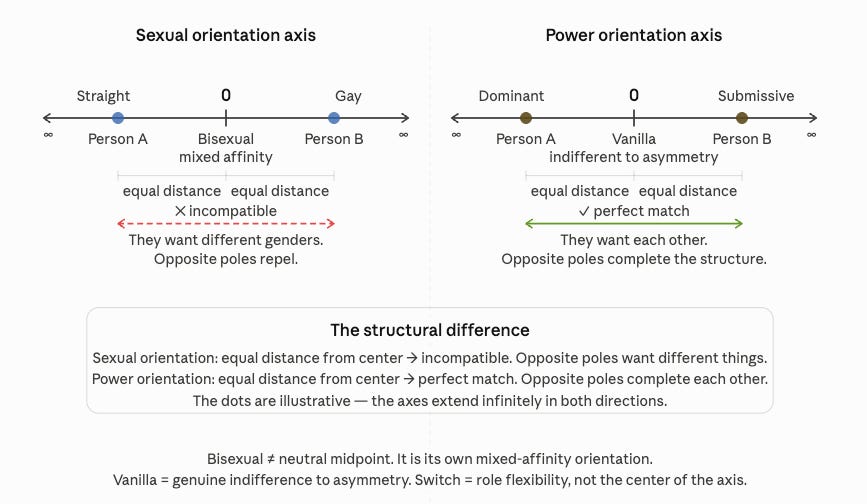
Bisexuality is not a neutral midpoint. It is not the absence of gender orientation. It is its own orientation structure — attraction to more than one gender, which is a genuine affinity, not a neutral position. The bisexual person is not someone who lacks orientation toward gender. They are someone whose orientation extends in multiple directions simultaneously.
The dominant/submissive axis does not work this way. The better analogy is top and bottom in gay male sexuality — a complementary bipolar axis where the midpoint is not vers but something closer to side: an indifferent position towards penetration sex, while people on equal distance from both sides complement each other the best. Vers, as switch of top/bottom, describes role flexibility and practice range within one sexual orientation. It does not describe the neutral center of that axis.
And here is what makes this concrete rather than merely theoretical: every self-identified switch I have encountered in thirty years of kink community involvement reports the same thing. One side of D/s is more natural, feels more like home. They may switch fluidly and genuinely — the switching is real, not performed — but within that fluidity, there is always a home base. One direction requires less effort, feels more inevitable, costs less to inhabit.
That home base is a Being-level fact. It may sit close to center. It may be subtle. It can shift gradually over a lifetime of experience like a personality trait. But it does not flip scene to scene. What switches have is varies levels of wider range of comfortable travel from that home base — into Expression and Doing on the other side — without the travel feeling inauthentic, forced or performative. That is a genuine and admirable capacity. It is not the same as having no orientation.
To crystallizes this: Switch doesn’t exist as a directionless midpoint. Switching exists as the capacity to travel how far from a home base that is still there.
The practical implication: the real question for someone who identifies as switch is not “where am I on the dominant/submissive axis?” but rather “where is my home base on the axis, how wide is my range on Expression and Doing level, and what determines which direction I travel in any given dynamic?” Those questions are the right ones to ask and explore.
VII. The Architecture: Being, Expression, Doing
BED+D proposes that power-exchange kink is structured in four layers. The first three — Being, Expression, Doing — describe the architecture as it exists. The fourth — Devotion — is the force that collapses the first three to make the architecture live. Each layer answers a different question. None of them alone explains what the others explain. Together they account for the full structure of what power exchange is and how it operates.
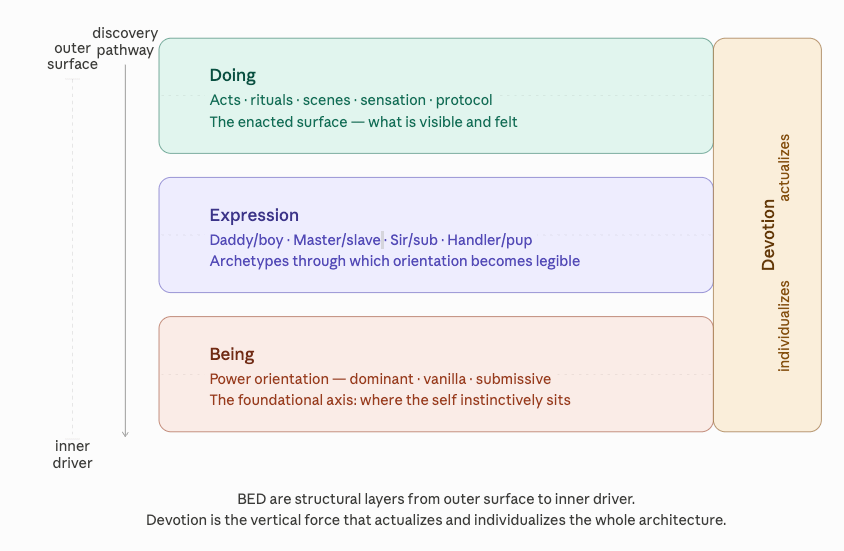
Being
Being is power orientation itself.
It is the foundational layer — the structural fact of where a person sits on the dominant/submissive axis, and at what depth. It answers: toward which side of asymmetry does the self lean? Is asymmetry merely interesting to this person, or is it organizing — the principle around which intimacy itself is structured?
Being is not identity in the vague self-help sense of “who I am at my core.” It is specifically about power orientation: the answer to which side of asymmetry feels like the self’s natural position, regardless of whether that position is ever enacted.
This is the layer that most people mean — but rarely say precisely — when they describe kink as something they are rather than something they do.
Expression
Expression is how power orientation becomes socially and symbolically legible.
It is the layer of archetypes, relational forms, and symbolic structures through which a person’s Being becomes visible — to themselves, to potential partners, and to community. Examples include: Daddy/boy, Master/slave, Sir/sub, Handler/pup, Owner/property, Brat/tamer, and etc.
As Pepper Mint observed, these archetypes are not invented from nothing. They are borrowed and transformed from the nonconsensual power dynamics of the wider culture — the authority of the military, the parent/child relationship, the master/servant structure — stripped from their original coercive contexts and repurposed as consensual relational forms. The leather community, the pup community, online D/s discourse: these are primarily communities of Expression. They provide vocabulary, aesthetics, protocols, and relational templates that allow an orientation to become legible and livable.
Expression is not the deepest thing. It is the form through which the deepest thing becomes structured and recognizable. The same dominant orientation can express as a stern paternal Daddy, a protocol-obsessed Master, or a quietly authoritative Sir. The orientation is the same; the expression is different.
This is why identity labels in kink are simultaneously meaningful and insufficient. They are meaningful because they create shared legibility. They are insufficient because two people using the same label may have profoundly different things at the Being level. The label lives at Expression. The architecture lives deeper.
Doing
Doing is the enactment layer: acts, rituals, scenes, protocols-in-practice, bodily sensations, behavioral expressions of asymmetry.
This is the most visible layer and almost always the first one encountered. It is also what most outsiders — and many insiders, many scene-based ones — mistake for kink itself. The checklist of practices, the negotiated scene, the physical vocabulary of power exchange: all of these live at Doing.
Sensation belongs here. Fetish dresses it up. The impact of a hand, the weight of a collar, the frustration of chastity, the smell of leather, the compression of rubber — these are the ways that asymmetry becomes real in the body. They matter enormously. But they are not foundational. They are the medium through which the foundational layer becomes felt.
The critical insight about Doing is this: the act never settles the meaning.
The same act can mean entirely different things depending on what organizes it. A person on their knees may be performing a scene, inhabiting an archetype, expressing a deep submissive orientation, or all three simultaneously. The act is identical in each case. The architecture is not.
A useful map of Doing sits on two axes — sensation intensity (low to high) and power asymmetry in enactment (low to high) — producing four loose zones:

Bondage can be Light Play (a visual art), Body Play (pure sensation), Pure Power (immobilization as control with minimal sensation focus), or Embodied Power (both physical suffering and mental helplessness simultaneously). The same rope, the same knot, the same person — entirely different architecture depending on what organizes the encounter. The practice cannot be classified by act alone.
VIII. Devotion: The Singularizing Force
Being, Expression, and Doing describe the architecture in abstract. Two people can share identical orientations, inhabit the same archetypes, and practice the same acts — and produce dynamics that feel categorically different in depth, meaning, and stakes. Some people may only be able to engage in certain archetype and actions when activated by a certain individual. What accounts for that difference is Devotion.
Devotion is not a role property. Most kink discourse treats it as a property of the submissive — loyalty, service, surrender. The dominant receives; the submissive gives. That is not what this framework means. Devotion is a bidirectional relational force generated between two specific people. It manifests differently on each side — not because of role but because of how each person’s orientation meets the specific other.
Submissive Devotion: loyalty beyond role compliance, service from genuine care, surrender specific to this person rather than available to anyone who fills the position.
Dominant Devotion: responsibility taken seriously rather than performed, protection that shapes actual decisions, commitment that persists when the relationship costs something.
Both parties have staked something. Both are exposed.
Devotion is the force that actualizes and individualizes the architecture. It collapses the three BED layers into a singular relationship — taking what would otherwise remain general structure and binding it to this person. The same dominant orientation can express as a warm spoiling Daddy with one partner and a stern sadistic Master with another. The same submissive orientation can produce pure sexless service in one dynamic and total surrender in another. Being doesn’t change. But Devotion determines what Expression it calls forth and what intensity of Doing becomes real. Without Devotion, the architecture exists in potential. With it, the architecture becomes alive. It makes the difference between a dynamic and the dynamic.
There is a further implication practitioners recognize but rarely theorize. Devotion doesn't just actualize what is readily available — it can unlock Expression and Doing that simply weren't accessible before. Some people find certain archetypes feel hollow with most partners but become fully inhabitable with one specific person. Some find certain acts arrive with completely different weight when Devotion is present. The person didn't change. The orientation didn't change. Devotion changed what the orientation could reach. This is why some people may only be able to engage certain archetypes and actions when activated by a specific individual — not a limitation, but a sign of how deep the architecture runs.
Devotion also explains what The Kink Den’s Contextual BDSM framework observes: that for some people, the power state "simply isn't there" outside of specific relational conditions. The right person doesn't just intensify the dynamic — they appear to activate it from nothing. BED+D doesn't believe there was nothing. The activation is either latent power orientation awakened — the orientation was always real, and this person found it — or primal substrate contacted — a genuinely vanilla person reaching the species-level baseline of hierarchy that is structurally available to all humans. Contextual BDSM accurately describes the phenomenology. BED+D explains the mechanism underneath.
Devotion is also what distinguishes lifestyle structures from scenes. Without it, even elaborate, frequent, intense dynamics remain essentially scene-bounded — meaningful within the encounter but not reorganizing either person’s life around the other. With it, even simple dynamics — without many doings, even without sex — become lifestyle structures, because Devotion is what makes the relationship irreplaceable rather than replaceable.
This is therefore where the deepest vulnerability lives — for both parties. Following Arendt: authority in power exchange is not possessed unilaterally. It is co-constituted — sustained by both parties' ongoing Devotion to the structure and to each other. When Devotion is present on both sides, the authority is real. When it is absent or asymmetric, what appears to be authority is performance wearing authority's face. The container must be genuine not just for the dynamic to function but for both people to survive its costs intact. Procedural consent is not designed to regulate the level at which Devotion operates. That level requires character, judgment, and genuine accountability — which is precisely what Race Bannon and the practitioner tradition have argued for decades.
IX. Build Your BED-frame For Compatibility
The checklist problem
Standard BDSM tests, checklists, and assessments — the community’s most common self-knowledge tools — typically present orientations, archetypes, and practices on the same plane as if they are items of equivalent type. Sadist, owner, and rope bondage appear as adjacent entries, rated on the same scale.
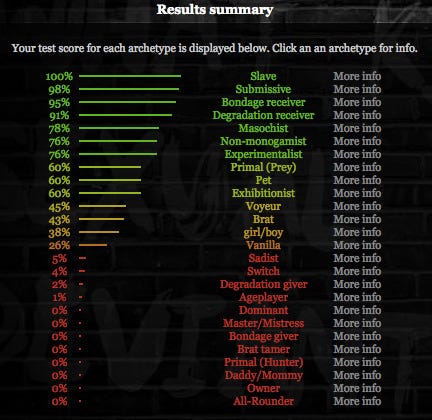
But these are not comparable items. They are not even the same kind of thing.
Sadist is a Being-level orientation. Owner is an Expression-level archetype. Rope bondage is a Doing-level practice. Placing them on the same list is like asking someone to rate their love of music, their preference for jazz, and their interest in the saxophone — and treating the three answers as telling you the same kind of thing.
Someone can be deeply dominant at the Being level with no interest in rope. Someone can love rope as pure sensation with no meaningful power orientation whatsoever. Someone can inhabit the Daddy archetype with great depth and little interest in pain. The act cannot tell you the architecture. The checklist cannot tell you the layer.
The result is compatibility assessment that operates only at the Doing surface, missing the two deeper layers where real fit is determined. Two people can match perfectly on a checklist and have completely incompatible architectures. Two people can match poorly on a checklist and discover they are structurally perfect for each other because they syncronize at the Being level.
The BED-frame introduction
The framework makes a better self-introduction possible — one that communicates architecture rather than just practice.
The syntax:
Here’s my BED-frame: I am a [depth + orientation] Being, who expresses primarily through [archetype], and whose Doing includes [practices].
Examples across different architectures:
“8/10 submissive Being, expressing primarily as boy in a Daddy/boy dynamic, Doing includes service, protocol, and physical discipline.”
“Moderate dominant orientation, Expression flexible between Sir/sub and handler/pup depending on the person, Doing runs to bondage, sensation, and behavioral control.”
“Extreme sadist, no strong power archetype — I live mostly in the Doing layer, heavy sensation and impact work, power is incidental.”
““Somewhat sub-leaning but very switchy in expression. Can be a nasty Dom but always need a Daddy to put me in my place. Wide range of intos, both give and receive, only hard limits are these three….”
“Submissive orientation, currently unexpressed — I know what I am at the Being level, haven’t yet found the archetype or the Doing that fits.”
That last example is important. It shows that the architecture can be partially populated — someone can have clarity at the Being level without having resolved their Expression or Doing. That is a real and common situation the checklist cannot represent at all.
BED compatibility vs. Devotion: the separation that matters
The framework makes a distinction the community has never cleanly articulated:
BED compatibility is assessable. Devotion is discoverable. You need the first before the second becomes realistic.
BED compatibility means: do these architectures fit? Does this Being-level orientation meet its complement? Does this Expression archetype find its corresponding form? Does the Doing overlap enough to make the dynamic workable? How much flexibility can we negotiate on the Expressions and Doings?
This is not a mechanical matching process. It is a framework for mutual understanding and negotiation that should happen before significant emotional investment. Orientation direction and depth matter here — a deep lifestyle submissive and a scene-based person with submissive preference are not Being-compatible for a lifestyle dynamic, even if they share orientation direction and understand each other’s needs. The depth mismatch produces a familiar frustration: one person for whom the dynamic is organizing, another for whom it is enhancement. The checklist may show them as compatible. BED assessment would show them as mismatched at the foundational layer.
Once BED compatibility is established — or is being explored with reasonable confidence — the dynamic can actually realize. And it is in the dynamic itself that Devotion either arrives or doesn’t. The early stages of a dynamic are not primarily for determining if the acts are right, or if the chemistry is sexual. They are for discovering whether Devotion is possible between these two specific people — whether this particular dominant, with this particular submissive, in this particular relational form, produces the singularization that turns a compatible architecture into an irreplaceable relationship that will last.
BED tells you whether the architecture fits. Devotion tells you whether the relationship is real.
Part 2 will take the framework further — into the philosophical and political foundations, the question of where orientation comes from and how it’s discovered, the quiet tragedy that happens when Devotion arrives before architecture is legible, and the social argument for why that tragedy is not just personal but systemic. It also addresses what makes power exchange legitimate, what this framework still cannot answer, and where the theoretical project goes from here.
Subscribe to receive Part 2.
References
Arendt, H. (1970). On Violence. Harcourt.
Bataille, G. (1957/1962). Erotism: Death and Sensuality. (M. Dalwood, Trans.) City Lights Books.
Bannon, R. (1992). Learning the Ropes: A Basic Guide to Safe and Fun S/M Lovemaking. Daedalus Publishing Company.
Foucault, M. (1978). The History of Sexuality, Volume 1: An Introduction. (R. Hurley, Trans.) Pantheon Books.
Mint, P. (2007). Towards a general theory of BDSM and power. Freaksexual.https://freaksexual.com/2007/06/11/towards-a-general-theory-of-bdsm-and-power/
Rubin, G. (1984). Thinking sex: Notes for a radical theory of the politics of sexuality. In C. Vance (Ed.), Pleasure and Danger: Exploring Female Sexuality (pp. 267–319). Routledge & Kegan Paul.
Aella. (2025). The other sexual orientation. Knowingless.
The Kink Den. (2026). Contextual BDSM - the Framework.


Race Bannon is on FetLife, and he linked me to you. I just followed him because you mentioned him. What started this following daisy chain was me searching "breaking social taboos" on FetLife that pulled up your diagram.
This piece has got my brain so excited. It feels so significant as an explanatory theory for kink with a power component… suddenly so much of the stuff I’ve struggled with in terms of sense of self and identity is clear by using this. Thank you for such an amazing piece of work which you’ve clearly poured so much time, effort and love into.
It does strike me that this framework is 95% of the way of also being able to explain fetish and kink without a power interest though, despite your humble claim that this is something separate. Having inhabited a number of different spaces over the years, Being and Doing are definitely relevant to the power-symmetrical space, as is Devotion. With expression +\- doing being functions of devotion, it feels like a symmetrical power space should be the result of a vanilla Being, scene-based Devotion and any descriptors for Doing. And perhaps the expression in this instance is actually the neutral point where there’s no borrowed power axis?
I have no idea if that makes any sense or would work. But your writing got me so excited about this. I can’t wait for part 2!