

After I shared my last piece about Pillion, my peer pillion David, the other founding member of our two-person fan club, sent me the recent BBC Culture article about how the film is dividing audiences, both outside and inside the kink community. That split doesn’t surprise me. In fact, it felt inevitable when I was watching it the first time.
Much of the debate seems to come from gaps among expectations and interpretations. The film was called playfully as a “Dom-com,” which makes it sound like a kinky rom-com with a reassuring emotional arc. What it actually delivers is something more complicated: emotionally knotty, morally grey, and intentionally uninterested in comforting us while being funny.
As someone who has lived long-term, 24x7 power-exchange dynamics, I come to this film not as someone speculating from the outside, but as a privileged submissive who is fortunate enough to find my counterparts to explore the deepest end of this power dynamic spectrum - sometimes beautifully, sometimes painfully.
So I want to respond to some of the discomfort and criticism surrounding the film, not to “win an argument”, but to offer context from lived experiences. As I mentioned in my first review, things from me are very biased, very personal. Major spoiler alert again - I highly recommend watching it first before reading this piece.
My overall observation: a lot of the negative reactions seem to rest on one assumption:
A different relationship that makes people uncomfortable = a wrong relationship
That’s not always true.
Portrayal ≠ Endorsement
One of the biggest criticisms is that the film doesn’t clearly condemn Ray, and therefore may be perceived as endorsing his behavior. But storytelling isn’t a public service announcement.
Ray is not presented as an ideal Dom. He’s peculiar but not uncommon. He’s emotionally distant, socially reserved and temperamentally stubborn and abrasive in ways that are sometimes sexy (believe me, a Dom with those traits + hot physical features = enigmatic, charismatic and lethally attractive in many gay subs’ math), and sometimes deeply damaging. The film doesn’t need a character to turn to the camera and say, “see, this is unhealthy”, for us to understand that Colin is eventually outgrowing what Ray can offer.
In fact, several people involved in the film have spoken about Ray being deliberately created as a morally grey character - someone we’re meant to question, not copy. Showing a flawed dynamic is not the same as validating and promoting it. If that were the case, the big majority of cinema’s great love stories - full of jealousy, imbalance, and heartbreak - would be moral failures.
Pillion trusts the audience to sit with complexity instead of simply handing out easy moral labels, knowing it’s a drama that’s doing what it supposed to do.
Negotiation ≠ Paperwork
Another common criticism is that we never see a formal negotiation: no checklist, no safeword talk, no explicit contract laying out protocols.
From an educational standpoint, sure, that would certainly be “correct”. The same applies to Heated Rivalry if showing a douching scene. But films aren’t workplace ethics workshops, and relationships don’t always follow the same meeting agenda.
Ray has a style. I’ve served Doms like that. I also have a Dom friend who fits that mold. It’s not the safest or most textbook approach, but it’s recognizable: he negotiates implicitly, through action, observation, and testing limits, still with self-imposed safety guardrails. He goes full throttle from the beginning, like those swimming coaches who throw kids into the pool on day one - learning by doing. He watches how the other person responds. He pushes, then adjusts. When Colin is clearly in physical distress during their first intense scene, Ray stops without being asked and offers a practical solution, suggesting they ease into things. That is communication. Not verbal, but still real.
Is that the gold standard of kink practice? No. But it is a way some dynamics unfold, especially when one partner is more experienced and the other is discovering their own capacity in real time. I believe I’m not the only sub who sometimes enjoys - or even prefers - this style. It creates adventurous and dramatic tension within the play. It’s a tango between two strangers: intense, occasionally clumsy, a thrilling exploration of each other with moves.
Coincidentally, the filmmaking in reality provides a perfect analogy - the two actors had never spoken with each other before they first met to jump into the wrestling scene on day one. Harry Melling in recent NYC showing Q&A said, “in hindsight it’s actually a very happy accident” because it created the chemistry that may have otherwise been lost.
And frankly, vanilla relationships aren’t that different. Most couples don’t sit down on the first date with a file binder and say, “here are my emotional boundaries, communication protocols, and long-term expectations.” They learn through interaction. They assume unspoken “rules” about affection, availability, exclusivity, until something emerges to be discussed, then change course.
We don’t call every romantic drama that shows poor communication “dangerous representation of heterosexuality”. We recognize it as realism. The drama is in the unspoken - just like in comedy, if a joke needs to be explained to not be misunderstood, it’s not funny any more.
And a word about “communication”: we often reduce it to “sit down and talk.” But plenty of research suggests most communication is nonverbal - depending on how you measure it, somewhere around 70% to 93%. A look, a facial expression, a touch, a finger snap - those can carry meanings words can’t. So “not speaking much” isn’t automatically equal to poor communication. Even inaction is communication. Ignoring the question “Is it good coffee?” is still a response: I don’t care. Don’t ask again. And just like that, a new protocol is set up.
In Pillion, the lack of explicit negotiation isn’t framed as ideal. It’s part of the emotional architecture. It’s consistent with Ray’s personality setting. It creates the drama - implicit structure works for Colin, until it doesn’t.
Submission ≠ Lack of Agency
Some critics treat Colin’s vulnerability or inexperience as proof that he has no real choice, so he’s manipulated into submission or “taken advantage of” by Ray.
But vulnerability does not erase agency. Many subs like me come to power dynamics with drives of longing, insecurity, and the desire to belong. That doesn’t make us mindless. We know what we are doing. We are not always passively accepting. Submission is an equal end opposite to dominance in D/s dynamics, holding the same amount of power and responsibility only with an imbalanced appearance. In fact, subs are capable of manipulating a Dom too - it’s not always the sub that gets hurt in a relationship from what I have seen.
Colin makes choices. He shows up. Ray gives him a glimpse of a new world he may not be aware of, but he actually asks for one more try - it’s an awakening. So he gets on that pillion. He’s shocked, but he returns. He consents. He stays. He participates. He voices his needs. And ultimately, he pulls himself out of a devastating ending of a relationship, gives himself the closure that Ray is coward enough to escape from, and becomes a more mature man and sub (with a beard). Most importantly, his experience with Ray doesn’t make him to abandon submission - instead, he’s clearer that he needs it and how he wants it, and he chooses someone else to restart. We heartbreak, we learn, we move on.
That arc is not victimhood. It’s growth. Treating Colin as a victim underestimates and undervalues him.
Assuming a new sub cannot meaningfully choose submission is, ironically, a very paternalistic way of thinking. It strips us of the autonomy critics claim to defend. We don’t need to be “saved”, we need to be understood.
Love ≠ Emotional Capacity
Ray is controversial. Every Dom I’ve spoken with about the film is quick to condemn Ray and distance themselves from him. I respect the ethical standards behind that reaction. But it would be too simple to assume Ray began with malicious intent and there was never love and care from him.
Yes, he starts from utility. Yes, he chooses Colin probably because he seems easy to slot into Ray’s structured world with low maintenance. But over time, emotion grows and Ray cracks. We see it in flashes: in the way he smiles when measuring Colin for his collar, in the deep look of bonding at the bonfire, in the way he awkwardly cares for Colin after his meltdown. And finally, in the kiss.
Ray’s emotional evolution stays subtle because he reads as severely avoidant - someone who only feels safe when there’s emotional distance. Unlike the kind of masking he may have to do in society, the dominant role actually lets him relax: power gives him permission to be unfiltered in front of a sub. He hides behind D/s protocols. The structure is his armor. When Collin kisses him, his line of defense collapses. Suddenly it’s not just power and control anymore - it’s emotional reciprocity. And that’s the one thing Ray can’t handle.
Ray’s limited emotional capacity and his abandonment of the relationship don’t mean there has been no love. On the contrary, it may mean the love is more than he is equipped to give and receive.
Discomfort ≠ Harm
Many kinksters worry: “how would the general public see us after watching this explicit and unapologetic movie?”. Even inside the kink community, the dynamics showing onscreen can make many uncomfortable - “this is too much”, “it’s not my way of kink”.
Let’s face it: almost everything we do in kink - restraint, humiliation, pain, authority, service, or simply Master/slave titles - can look very wild, wrong, or abusive from a vanilla perspective. If you strip away context, the optics alone can be unacceptably alarming. You cannot wake up someone who pretends to be sleeping - for someone who refuses to understand us, no amount of self-censorship would make a difference. So why not be more authentic anyway? At least it’s more fun.
What makes the fundamental difference is consent. And it’s a universal concept applicable to every relationship.
Before Colin reaches the point where he says “I want to be happier” - meaning he wants more emotional intimacy beyond the existing structure - what we’re watching has been a consensual dynamic. Ray’s style and protocol are intense and may feel extreme to a vanilla audience, but Colin chooses to enter and remain in that structure. He finds pride, purpose, and identity inside it. He expresses his love from a sub’s identity, not as a vanilla boyfriend.
The relationship isn’t perfect, but no relationship is. Discomfort from the outside doesn’t automatically make it harmful to the person inside it. Colin is a consenting adult. Whether he is fulfilled or not at that stage of the story is something only he can determine, not outside observers projecting their own standards onto him.
On the other hand, we have to be clear that consent is not a one-time event, nor a blank check. It evolves as people evolve.
Once Colin’s needs expand, once he begins reaching for something beyond service and protocol, the ethical responsibility shifts too. Ray refuses to renegotiate, and continues the dynamic as if nothing has happened, and Colin basically retracts his consent to the whole structure by rebelling it once his negotiation attempt hits Ray’s wall. If Ray were to keep enforcing the dynamic at that point, punishing Colin simply to restore the status quo, that’s where his behavior would become ethically questionable and potentially harmful.
At that stage, what was once a consensual structure risks turning coercive. Same action can carry totally different meaning now. And then people would have every right to be uncomfortable - not because power exchange itself is abusive, but because consent is no longer present.
I’ve been at that Colin-point myself. There was a time when I could no longer carry the emotional weight of a dynamic I had once embraced. I needed something closer, more secure, more emotionally rooted. The structure couldn’t meaningfully change, yet it kept going. Eventually, I chose to leave.
I documented parts of my slave life on Tumblr back then. Some of it still exists. If Colin’s experience reads as “discomfort” to some viewers, mine went far deeper and more intense. But the way the relationship ended doesn’t automatically mean any of those was harmful from the start - in fact, I was living a life I dreamed for until my submission needs evolved.
Unhealthy ≠ Meaningless
Another reaction I see is: If this relationship isn’t healthy, how can it be called love - even tender - at all?
Because not every love that changes us is sustainable. Not every relationship that helps us grow is meant to last. But when we’re in it, it’s still love nonetheless.
Colin’s journey isn’t about finding a perfect Dom, falling in love, and living in a model D/s dynamic happily ever after. It’s about discovering himself - his needs, his limits, his voice, through the love he expresses in a language of act of service, which both empowers and fails him. His love is tender - even more so with a heartbreak ending.
I know this not just from theory, but from my own life. The most dramatic, painful, and transformative relationship I’ve ever had was like a shooting star - intense but burned fast, probably the unhealthiest. It taught me more than any experience before - about attachment, self-worth, and closure. Regardless, I’ve never felt the need to regret that I loved, or to deny it was love just to make the ending easier.
Just like Colin - He falls in love at first sight, depressed in limerence. He tolerates the emotional distance. He begs for intimacy. He goes through the most devastating discard without a word of explanation or apology. Sometimes the relationships that hurt the most are also the ones that become most meaningful - they teach us who we really are and what we actually need. That’s why we still need this story and this movie.
Different ≠ Wrong
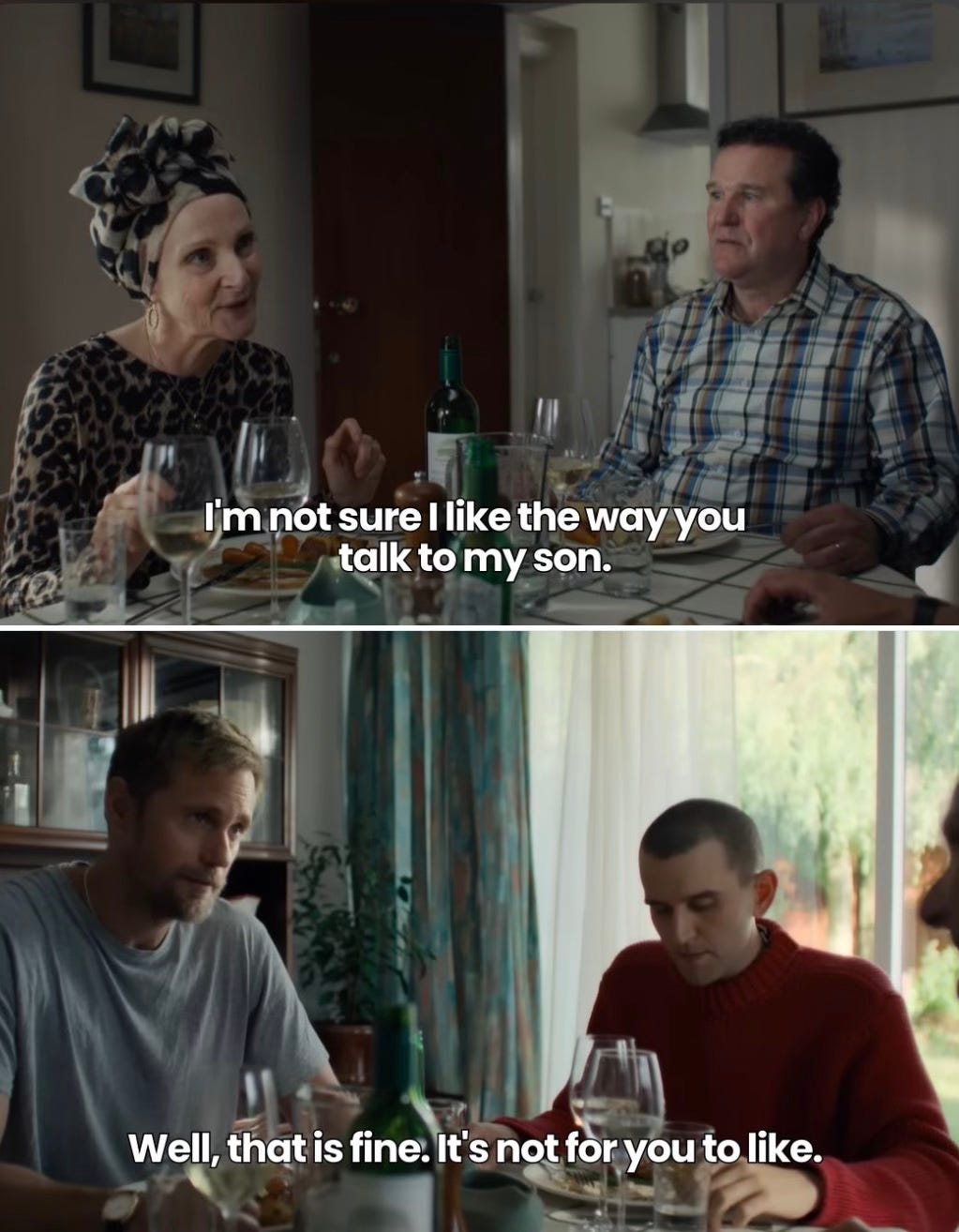
At dinner, Colin’s mother gets angry at Ray, “I’m not sure I like the way you talk to my son.” Ray replies:
“I can see I’m making you uncomfortable - our relationship makes you uncomfortable, and that’s okay. But deciding what makes you uncomfortable is bad for your son… honestly that’s a pretty backward way of thinking.”
He’s blunt, and inconsiderate of the dying mother. But he’s not wrong.
If this were about Colin simply being gay, and his otherwise loving and caring mother said she was uncomfortable with his relationship with a man at the table (who’s 20 years older, if we want to add another layer of complexity), we’d immediately see the problem and agree more with Ray. Power exchange is just much more prone to provoke a similar reaction because it challenges the common assumptions about equality and romance ingrained in the society. But being different doesn’t mean it’s wrong. So many kinksters have to hide or have a “second come-out” to be true to themselves because of this common attitude towards kink. Let’s not internalize it ourselves.
Not for You ≠ Not Real Love
You don’t have to want a relationship like Colin and Ray’s.
You don’t have to see it as healthy or aspirational.
But seeing a form of intimacy we don’t personally understand, want or agree with should not lead to a conclusion that it’s unacceptable and shouldn’t exist. Dismissing it as inherently abusive or irresponsible representation misses something essential. Pillion isn’t just showing kink. It’s showing another format of love - one that strips away social scripts and goes straight to some of our most primal human needs: safety, pride, belonging.
This kind of love asks for something radical: the bravery to give absolute trust without guarantees, and the strength to hold that trust with care and protection in return. It can look unequal. It can look intense. Sometimes it can look painful from the outside to make people flinch in fear and disbelief. It’s not for the faint of heart.
But that doesn’t make this love less qualified. On the contrary, I’d argue it’s the deepest love someone can experience in life.
The struggles we see in Pillion - mismatched needs, emotional limits, the ache of wanting more than someone can give - aren’t kink problems. They’re universal human struggles in eternity. Power exchange just makes them visible in sharper relief.
The film is about the love that has nothing to do with social labels, romantic formulas, or what relationships are “supposed” to look like. It’s about that sometimes the most unequal-looking bonds are built on the most sincere and courageous attempts to connect, to belong and to be needed.
Not all love is soft.
Not all love lasts.
But that doesn’t make this one any less than.
This is excellent. It's honestly one of the best writings about Pillion I've read. Well done.
Thanks for this! I was looking for a review of the movie from someone within the community to get some perspective, and this really helps me sort out my thoughts and reflect on my reaction to the movie. Cheers :)